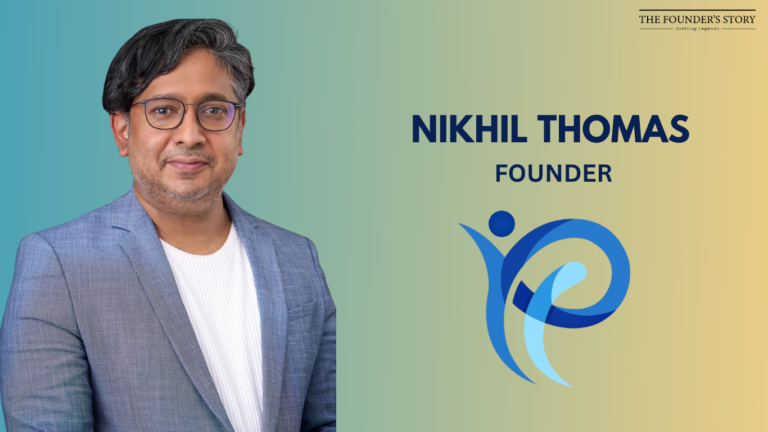
In the rapidly evolving world of workforce digitization, few founders are tackling complexity with as much clarity as Nikhil Thomas. As a forward-thinking entrepreneur, his founder story reflects a deep understanding of operational inefficiencies within manpower businesses. Through his startup Peepli.ai, he is building a unified ecosystem that redefines how manpower companies manage their operations end-to-end. Instead of adding yet another tool to an already fragmented landscape, Nikhil is focused on solving a deeper integration challenge, thereby creating a truly transformative ManOps operating system.
Nikhil Thomas is a visionary founder and entrepreneur who combines sharp business acumen with a strong product mindset. Over the years, he has demonstrated an ability to identify overlooked inefficiencies and convert them into scalable startup opportunities. His journey into the manpower domain was not accidental; rather, it was shaped by immersive, ground-level exposure to real operational challenges. Consequently, he brings a rare blend of empathy and technical clarity to the table. As a founder, he strongly believes in building systems that simplify complexity while preserving operational depth. This philosophy has become the foundation of Peepli.ai’s growth story.
TFS: Hi Nikhil, it’s great to have you with us today. Your founder story and the journey of Peepli.ai have been gaining significant attention in the startup ecosystem. To begin with, could you briefly introduce Peepli.ai and what makes it unique?
Nikhil Thomas: Thank you, it’s a pleasure to be here. Peepli.ai is essentially a Manpower Operations (ManOps) operating system designed to unify the entire workforce lifecycle. While many tools focus on isolated problems, we built Peepli.ai as a connected ecosystem. As a result, manpower companies can move away from fragmented systems and operate with a single source of truth.
TFS: Can you tell us the story behind Peepli.ai? What inspired you to build an all-in-one operating system for manpower companies rather than focusing on a single tool?
Nikhil Thomas: The inspiration for Peepli.ai did not come from a traditional startup brainstorming session. Instead, it emerged from two years of deep, firsthand exposure to the manpower industry. During that time, I closely observed an industry veteran with over two decades of experience managing large-scale workforce operations in the UAE. Although he possessed immense expertise, he constantly struggled with inefficiencies caused by fragmented systems.
Moreover, I noticed a recurring pattern. Companies were not lacking tools; instead, they were overwhelmed by too many disconnected tools. For example, they used one platform for payroll, another for scheduling and several others for compliance. Consequently, this led to what I call “data leakage,” where critical information gets lost between systems.
Therefore, we realized early on that the industry does not have a feature problem; it has an integration problem. Instead of building yet another niche tool, we decided to create a unified ManOps OS. By doing so, we provided a central nervous system that connects every operational touchpoint. As a result, companies can eliminate silos, reduce manual effort and focus more on people rather than paperwork. This shift is what defines our founder story and startup vision.
TFS: Every founder hits roadblocks—what was the toughest challenge you faced while turning Peepli.ai from an idea into a live platform?
Nikhil Thomas: The biggest challenge was not a single obstacle but the sheer architectural complexity of building an all-in-one platform. When you develop a single-feature tool, your scope remains limited. However, when you attempt to build an operating system for an entire industry, the complexity increases exponentially.
For instance, every module—from visa tracking and compliance to AI-driven OCR and invoicing—must communicate seamlessly in real time. Therefore, the challenge was not just technical execution but also system orchestration. Additionally, we had to translate decades of “tribal knowledge” into structured workflows.
Another layer of difficulty came from the chaotic nature of real-world operations. Companies relied on WhatsApp images, spreadsheets and inconsistent documentation. Hence, we had to simplify this chaos without losing operational depth. We spent months refining workflows to ensure that stakeholders across departments could access the same data. Ultimately, the breakthrough came when we successfully created a unified interface that mirrored real-world processes while improving efficiency.
TFS: When you think 5 years ahead, what impact do you hope Peepli.ai will have on the manpower industry?
Nikhil Thomas: Over the next five years, I envision Peepli.ai becoming the global standard for ManOps. Just as CRM platforms redefined customer management, we aim to redefine workforce operations. However, our impact goes beyond efficiency alone.
We are focused on enabling transparency and predictability. For example, companies using our platform can track profitability in real time. Instead of waiting until month-end, they can make proactive decisions daily. Consequently, businesses shift from reactive management to predictive strategy.
Furthermore, this transformation has a human impact. By professionalizing back-office operations, we create a more organized and transparent environment for workers. Therefore, our long-term vision is not just operational excellence but also improving the overall workforce experience globally.
TFS: Peepli.ai has 50+ modules and caters to multiple roles. How did you decide which features were essential to unify under one platform?
Nikhil Thomas: Our approach was fundamentally different from traditional product development. Instead of adding features incrementally, we mapped the entire lifecycle of a worker. As a result, every module represents a critical touchpoint in that journey.
For example, the process begins with lead approval and continues through document verification, allocation, timesheet tracking and invoicing. Therefore, we ensured that all these elements exist within a single ecosystem. This approach guarantees a consistent data flow and eliminates discrepancies.
Additionally, we prioritized building a robust web-based platform first. In high-stakes environments like manpower, detailed operations require a powerful interface. While mobile accessibility is important, the core system must handle complex workflows. Consequently, we focused on building a strong foundation before expanding convenience features.
TFS: Your AI-powered timesheet OCR is impressive. Can you walk us through how you built it and achieved such high accuracy?
Nikhil Thomas: Achieving over 95% accuracy required a layered approach rather than reliance on a single technology. First, we built a hybrid intelligence pipeline. This includes primary OCR engines capable of handling complex environments such as low-quality images captured on-site.
However, the real differentiation lies in our custom logic layer. Unlike generic OCR systems, Peepli.ai understands manpower data. For instance, it recognizes multiple timesheet formats and applies intelligent corrections based on predefined rules. Therefore, even if the system misreads a character, it can auto-correct it based on context.
Moreover, we incorporated a human-in-the-loop verification system. While AI performs most of the processing, final validation remains with a human reviewer. This combination ensures both speed and accuracy. As a result, companies save significant time without compromising data integrity.
TFS: In complex workflows like employee allocation or lead approvals, how do you strike the right balance between automation and human oversight?
Nikhil Thomas: We follow what we call the “Guardrail Principle.” Essentially, we automate repetitive tasks while preserving human judgment. For example, in employee allocation, the system suggests optimal matches based on data. However, the final decision remains with the manager.
Similarly, in lead approvals, AI performs initial validations. It checks for duplicates and verifies documents. However, financial decisions are still made by humans. Therefore, the system enhances decision-making rather than replacing it.
This approach ensures accountability while improving efficiency. Additionally, our audit trails provide complete transparency. Every action is recorded, which strengthens governance without adding bureaucracy.
TFS: When you first spoke to manpower companies, what were the most common pain points and how does Peepli.ai address them?
Nikhil Thomas: We consistently observed three major pain points across companies. First, data fragmentation was a universal issue. Businesses relied on multiple disconnected systems, which created inefficiencies. Therefore, we solved this by building a unified OS.
Second, timesheet management was extremely chaotic. Manual data entry consumed hours daily and often resulted in errors. Consequently, our AI-powered OCR reduced this effort significantly while improving accuracy.
Third, companies lacked real-time visibility into profitability. Most decisions were reactive because insights came too late. Hence, we introduced real-time analytics dashboards. This enables proactive decision-making and improves overall financial performance.
TFS: Do you have a story of a client who saw tangible improvement in efficiency or profitability?
Nikhil Thomas: Yes, one of our clients in the UAE had over 800 employees. Initially, they spent nearly 20 hours per week on manual timesheet entry. After implementing Peepli.ai, this reduced to just 3 hours.
However, the real impact was on accuracy and profitability. Payroll errors dropped to zero. Additionally, our analytics helped them identify underperforming contracts. Within two months, they optimized operations and saved a significant amount in costs.
This example clearly demonstrates how eliminating inefficiencies leads to measurable business outcomes. It validates our startup thesis and reinforces the importance of integration.
TFS: There are other HR, invoicing and payroll tools out there. How do you differentiate Peepli.ai from these point solutions?
Nikhil Thomas: The key difference lies in integration versus isolation. Most tools operate independently, which creates silos. In contrast, Peepli.ai functions as a connected ecosystem.
For example, invoicing in our system is linked to verified timesheets and compliance checks. Therefore, it ensures accuracy at every stage. This eliminates reconciliation issues that are common in traditional systems.
Ultimately, we are not just building tools. Instead, we are creating a unified operational framework that connects every department.
TFS: With multiple dashboards and audit trails, data security must be critical. How do you ensure compliance and keep sensitive data safe?
Nikhil Thomas: Security is a foundational aspect of our platform. We use role-based access control to ensure that users only access relevant data. Additionally, all actions are recorded in immutable audit trails.
From a technical perspective, we rely on secure cloud infrastructure with encrypted connections. We also implement advanced authentication mechanisms. Furthermore, we comply with global data protection standards.
Therefore, our approach ensures both security and usability. Users can access necessary data without compromising safety.
TFS: Scaling software globally is never simple. How are you approaching expansion while keeping the platform intuitive for new users?
Nikhil Thomas: Our strategy focuses on depth before breadth. We are initially optimizing the platform for regions like the GCC. This allows us to build strong domain expertise.
For usability, we designed role-based dashboards. Each user sees only what they need. Additionally, we use progressive disclosure to introduce features gradually. Therefore, users are not overwhelmed.
This approach ensures a smooth onboarding experience while maintaining system depth.
TFS: Was there anything that surprised you about how manpower companies actually use Peepli.ai versus what you initially imagined?
Nikhil Thomas: Yes, the level of cross-functional usage surprised us. Initially, we expected each department to use specific features. However, users began exploring other areas.
For example, sales teams started tracking procurement data. Similarly, procurement teams used financial insights. This showed that when data is unified, collaboration improves naturally.
TFS: AI and automation are evolving fast. Are there any upcoming features or tech enhancements you’re particularly excited about for Peepli.ai?
Nikhil Thomas: We are currently focusing on predictive capabilities. Our upcoming features include workforce forecasting and profitability simulation. These tools will help companies plan proactively.
Additionally, we are enhancing OCR with adaptive learning. This will further improve accuracy. Overall, our goal is to enable smarter decision-making through AI.
TFS: Looking at the bigger picture, how do you see AI reshaping manpower management over the next decade?
Nikhil Thomas: AI will transform manpower into a predictive industry. Companies will forecast workforce needs in advance. Compliance will also become automated.
Moreover, profitability optimization will happen in real time. However, human expertise will remain essential. AI will act as an enabler rather than a replacement.
TFS: Finally, for other founders trying to create an “all-in-one” platform in a complex industry, what one piece of advice would you give?
Nikhil Thomas: My advice is simple: start with data, not features. Understand how information flows across the system. Then build your architecture around that.
Additionally, embrace complexity rather than avoiding it. Your role as a founder is to simplify complexity without losing depth. This mindset is crucial for building scalable platforms.
TFS: Nikhil, this has been an incredibly insightful conversation. Your founder story and the vision behind Peepli.ai truly stand out in today’s startup ecosystem.
Nikhil Thomas: Thank you, I appreciate the opportunity to share our journey. It has been a challenging yet rewarding experience and we are just getting started.
TFS: We look forward to seeing Peepli.ai shape the future of manpower operations globally.
Nikhil Thomas: Absolutely and we remain committed to building technology that empowers both businesses and people.