
The Psychology of Leadership: Corina Taban Helps Organizations Recover Lost Execution
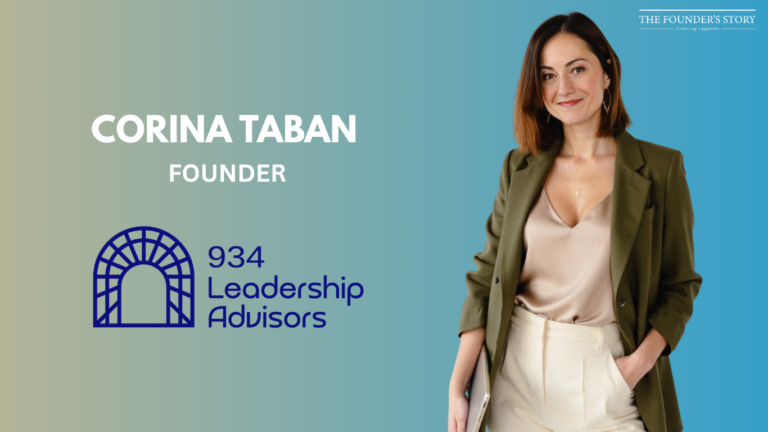
In today’s evolving leadership landscape, few founder stories combine corporate excellence, behavioral science, and entrepreneurial vision as powerfully as that of Corina Taban. After building an impressive career at globally recognized companies such as Microsoft and Meta, Corina stepped into entrepreneurship with a clear mission. She wanted to redefine how organizations understand leadership, decision-making, employee engagement, and workplace culture. Today, through 934 Leadership Advisors, she helps organizations build healthier, higher-performing teams by blending psychology, neuroscience, organizational behavior, and business strategy into practical leadership transformation programs.
As a founder, entrepreneur, researcher, and leadership advisor, Corina brings a rare perspective to the modern workplace conversation. Her work focuses deeply on the hidden dynamics that shape execution, engagement, trust, and organizational performance. Through doctoral research and hands-on advisory work, she continues to challenge outdated leadership assumptions while helping companies create workplaces where people genuinely thrive. In this exclusive founder interview, Corina shares her entrepreneurial story, leadership philosophy, and vision for the future of work.
TFS: Corina, it’s such a pleasure to welcome you today. Your founder story is incredibly inspiring because it bridges corporate leadership, behavioral science, and entrepreneurship so seamlessly. We’re excited to dive deep into your journey, your work at 934 Leadership Advisors, and your perspective on the future of leadership.
Corina Taban: Thank you so much. I’m genuinely happy to be here. Leadership, human behavior, and the future of work are topics I care deeply about, so I’m excited for this conversation.
TFS: Your career spans Microsoft, Meta, and now entrepreneurship—what was the turning point where you realized you wanted to build something of your own?
Corina Taban: Honestly, I never started my career thinking I would become a founder or entrepreneur. I did not grow up surrounded by startup culture, and I also did not have many entrepreneurs in my close environment. Because of that, entrepreneurship never felt like an obvious career path for me in the beginning.
For most of my professional journey, I followed what many ambitious professionals naturally pursue. I focused on building meaningful work experiences, learning from exceptional people, and growing within world-class organizations. My time at companies like Microsoft and Meta gave me extraordinary exposure to innovation, complexity, and high-performance cultures. I had the opportunity to work alongside incredibly intelligent people while contributing to projects that genuinely mattered.
However, there came a point when I started thinking about what I wanted from the next chapter of my career. Naturally, I began exploring opportunities across the industry. I took meetings, interviewed for roles, and had many conversations with companies. Yet despite the quality of those opportunities, nothing truly excited me. Nothing created that internal energy that tells you, “This is the right direction.”
That realization became incredibly important for me. I started reflecting deeply on the moments in my career when I felt the most alive, energized, and fulfilled. Interestingly, the answer was always the same. The moments that brought me the most fulfillment were the moments where I was building something new. I loved steep learning curves. I loved uncertainty. I loved creating from scratch. I loved solving difficult problems while continuously evolving myself in the process.
The turning point itself was not dramatic. There was no grand revelation or cinematic moment. Instead, it was a very quiet but powerful realization. The moment I seriously considered building something of my own, I immediately felt an enormous sense of excitement and clarity. The energy shift was instant. I suddenly knew, without hesitation, that this was the direction I wanted to pursue.
That was really the beginning of my founder journey and entrepreneurial story. It was less about escaping corporate life and more about moving toward the kind of work that genuinely energized me.
TFS: Looking back, what early experiences—personal or professional—most shaped your perspective on leadership and human behavior at work?
Corina Taban: A major influence on my thinking about leadership came from my experience at Microsoft. The culture there had a profound impact on me because it combined performance, intelligence, humanity, and growth in a very balanced way. The leadership environment emphasized learning, curiosity, and respect for people, which shaped how I think about organizations even today.
I was hired into a role that honestly exceeded my level of experience at the time. It was a significant opportunity, and I remember feeling both excited and intimidated by the responsibility. Fortunately, I had an exceptional manager named Gilles, who played an enormous role in my development during that period.
What made his leadership so impactful was the balance he created between support and autonomy. He trusted me with meaningful responsibility while also creating a psychologically safe environment where I could grow into the role. That combination is incredibly powerful for developing talent. Too much control limits growth, while too little support creates unnecessary fear and confusion. He understood how to balance both.
Additionally, many of the senior leaders I encountered during that time were not only highly capable but also genuinely kind people. That combination stayed with me because leadership is often mistakenly associated only with authority, confidence, or intelligence. However, the leaders I admired most demonstrated humanity alongside competence.
That experience significantly shaped my understanding of what effective leadership looks like. It showed me that organizations perform better when leaders create environments built on trust, learning, and psychological safety.
As for human behavior, that fascination has existed for a very long time in my life. I have always been deeply curious about why people think, behave, react, and make decisions the way they do. Human psychology influences every aspect of organizational life, including communication, motivation, conflict, trust, collaboration, and innovation.
That curiosity eventually evolved into a serious academic and professional focus. Today, it sits at the center of my work as a founder, researcher, and leadership advisor.
TFS: What inspired you to start 934 Leadership Advisors, and what gap did you see in the leadership development space that others were missing?
Corina Taban: One statistic profoundly shaped my thinking. According to Gallup, approximately 79% of employees are disengaged at work. When you truly sit with that number, it becomes difficult to ignore the scale of the problem. Nearly four out of five people spend a huge portion of their lives doing work that does not emotionally engage them.
I fundamentally believe meaningful and fulfilling work should not be rare. It should be the standard. People spend too much of their lives at work for disengagement to be treated as normal.
Over the last four years, my doctoral research has focused heavily on the psychological contract between employees and organizations. The psychological contract refers to the unwritten expectations, obligations, and assumptions that exist between both sides. These expectations rarely appear in formal contracts, yet they shape nearly every aspect of the employee experience.
Employees develop beliefs about what they owe the organization and what the organization owes them in return. When those expectations are fulfilled, trust and engagement grow. However, when those expectations break down, disengagement, frustration, and distrust emerge very quickly.
What became increasingly clear through my research was the central role leadership plays in shaping that entire experience. Great workplaces do not happen accidentally. Leaders create them through their daily behaviors, decisions, communication patterns, and priorities.
That insight became the foundation of “934 Leadership Advisors”.
The leadership development industry is extremely crowded today. However, much of the industry still treats leadership as a collection of isolated skills rather than a complex human system. Many programs focus heavily on surface-level competencies while ignoring the psychological, emotional, and organizational dynamics underneath.
I wanted to build something different. I wanted to create a leadership advisory company grounded in real evidence from psychology, neuroscience, organizational behavior, and behavioral science. At the same time, I wanted the work to remain highly practical and execution-oriented.
My goal was never to deliver leadership theory that sounds impressive in a conference room but changes nothing operationally. Instead, I wanted to help organizations create measurable behavioral change while putting humans back at the center of workplace design.
That mission continues to drive my founder journey every single day.
TFS: What was the biggest challenge you faced when transitioning from corporate leadership roles into becoming a founder?
Corina Taban: The biggest challenge was probably the sheer complexity of becoming a first-time founder while building everything independently. In corporate environments, even very demanding ones, there are systems, structures, specialized teams, and operational support around you. Entrepreneurship removes most of that overnight.
Suddenly, I was responsible for everything simultaneously. I was building content, conducting research, developing thought leadership, handling marketing, managing sales conversations, overseeing accounting, running social media, delivering keynotes, facilitating training programs, and ensuring the overall business aligned with the standards I expected from myself.
At first, everything felt equally urgent and equally important. That creates enormous cognitive overload for founders because your attention becomes fragmented across too many priorities at once.
Additionally, I spent a lot of time taking meetings and exploring opportunities because, as a startup founder, you initially believe opportunities can emerge from anywhere. While that openness is valuable early on, it can also create noise and distraction.
Interestingly, the hardest part was not necessarily the workload itself. I actually enjoy hard work. The difficult part was the feeling of exerting massive energy while not always seeing proportional forward momentum.
The real shift happened when I became extremely disciplined about prioritization. I started identifying what genuinely moved the business forward and what merely created the illusion of productivity. Once I gained that clarity, I became much more intentional about where my energy went.
Today, I can honestly say I feel far more aligned with the work that matters most. That clarity has been transformative both professionally and personally.
TFS: You focus strongly on manager disengagement—why do you believe this is one of the most overlooked yet critical issues in organizations today?
Corina Taban: Manager disengagement is one of the most underestimated organizational risks today because managers directly influence the experience of entire teams. Research consistently shows that managers account for roughly 70% of employee engagement outcomes.
That means when a manager disengages, the effects ripple outward very quickly. Team motivation declines. Communication weakens. Psychological safety deteriorates. Decision-making slows down. Trust erodes. Innovation suffers. Productivity declines. Eventually, organizations experience these consequences operationally, but they often fail to identify the original source.
One reason this problem gets overlooked is because organizations tend to assume managers are fine simply because they occupy leadership positions. Employees are treated as individuals with emotional experiences, while managers are often treated as extensions of the organizational system itself.
Another issue involves how organizations select managers in the first place. Many companies promote their strongest individual contributors into management roles. While that decision appears logical initially, the competencies required for individual performance are often very different from the competencies required for leadership.
A brilliant engineer does not automatically become a strong people leader. A high-performing salesperson does not automatically become an exceptional manager. Leadership requires emotional intelligence, communication skills, coaching capability, conflict management, systems thinking, and self-awareness.
There is also a structural issue around incentives. In many organizations, career advancement primarily flows through management. Therefore, people often pursue leadership roles not because they genuinely want to lead people, but because management becomes the only path toward higher compensation, status, or influence.
Then, of course, there is the Peter Principle, which remains incredibly relevant today. People continue getting promoted until they reach roles where they are no longer effective. Unfortunately, organizations rarely intervene early enough.
The encouraging part is that many of these problems can absolutely improve through intentional leadership development, advisory work, coaching, and organizational redesign. That is a major part of the work I do through 934 Leadership Advisors.

TFS: Many leadership development programs fail to create long-term impact. In your view, what are most organizations getting wrong?
Corina Taban: Interestingly, leadership development itself is not inherently ineffective. Research from McKinsey shows leadership development programs can generate significant returns on investment. Therefore, the problem is not that leadership training lacks value.
The issue is that many organizations begin training initiatives without sufficient strategic clarity. They launch programs because leadership development sounds important, yet they have not defined the actual outcomes they want to achieve.
Before any meaningful development work begins, organizations need to answer critical questions. What exactly are we trying to improve? Are we developing knowledge, behavioral skills, emotional awareness, decision-making quality, habit formation, communication capability, or mindset transformation? How will success be measured? What business outcomes should improve? What specific organizational context are we solving for?
Without those answers, even excellent leadership programs struggle to create lasting behavioral change.
I have seen situations where world-class facilitators deliver excellent content, yet the organization experiences little operational improvement afterward because the broader system was never aligned around implementation.
Leadership development cannot exist in a vacuum. It must connect directly to organizational priorities, cultural realities, operational pressures, and measurable behavioral expectations.
That is why I insist on deep upfront diagnostic conversations with organizations before designing any leadership intervention. Clarity at the beginning dramatically improves long-term impact.
TFS: Your work blends psychology, neuroscience, and business strategy—how do you make those insights practical for fast-moving tech teams?
Corina Taban: The reality is that fast-moving technology teams do not have patience for abstract theory. They operate in environments defined by speed, ambiguity, execution pressure, and constant change. Therefore, if research cannot translate into practical action quickly, it becomes irrelevant.
I view psychology, neuroscience, and organizational behavior as foundational disciplines rather than the final product itself. My responsibility is to translate those insights into practical tools leaders can immediately apply.
In practice, that means simplifying complexity without oversimplifying truth. Leaders need clarity around why specific behaviors emerge, what evidence-based research says about them, and what concrete actions can improve outcomes.
I also maintain a very high standard regarding the quality of the research I incorporate into my work. The leadership industry often becomes vulnerable to trends, buzzwords, and unsupported claims. If a concept lacks strong evidence, I do not use it simply because it sounds compelling.
Additionally, I translate everything into the real operating environment leaders face daily. That includes difficult conversations, organizational tension, uncertainty, conflict, prioritization, execution breakdowns, burnout, and decision fatigue.
The goal is always practical application. Leaders should leave conversations with frameworks, tools, and behavioral insights they can use immediately inside their teams.
TFS: If you could challenge one common leadership belief that many organizations still hold onto, what would it be?
Corina Taban: I would challenge the belief that leadership is an innate trait that only certain people naturally possess.
Organizations often behave as though leadership ability is fixed. They assume some individuals simply “have it” while others do not. That mindset becomes dangerous because it removes responsibility for leadership development from the organization itself.
In reality, very few people are naturally born with the full set of capabilities required for effective leadership. Most exceptional leaders develop through continuous learning, reflection, failure, adaptation, and self-awareness.
The strongest leaders I know consistently work on themselves. They remain intellectually curious. They actively seek feedback. They examine their blind spots. They evolve continuously.
To me, leadership is not defined primarily by charisma, confidence, or positional authority. Leadership is defined by the willingness to keep growing while helping others grow alongside you.
That learning mindset is what truly separates strong leaders from ineffective ones.
TFS: You talk about helping organizations “recover months of lost execution.” What are the hidden inefficiencies that usually slow teams down?
Corina Taban: Most execution problems inside organizations are not caused by intelligence gaps. They are caused by unresolved human dynamics that quietly drain momentum over time.
For example, misalignment often appears resolved during meetings, yet resurfaces repeatedly during execution. Teams leave conversations believing they agree, while actually operating from very different assumptions.
Similarly, many organizations repeatedly relitigate decisions instead of moving forward. Teams revisit conversations endlessly because alignment never became fully established the first time.
Conflict avoidance is another enormous source of inefficiency. When organizations avoid difficult conversations, tension does not disappear. Instead, it spreads indirectly across meetings, communication patterns, and team relationships.
Role ambiguity also creates major operational friction. Many employees spend significant time working on priorities that do not meaningfully contribute to business outcomes because expectations were never clearly defined.
Additionally, disengaged talent creates invisible organizational drag. Employees may still appear productive externally, yet internally they have emotionally disconnected from the work. Their creativity, discretionary effort, and strategic thinking disappear long before they physically leave the organization.
When organizations accumulate these inefficiencies across multiple teams and quarters, the execution loss becomes enormous. That is where companies lose months of operational momentum without fully understanding why.
TFS: From your experience, what is the real reason decision-making becomes slow in organizations—is it process, culture, fear, or something else?
Corina Taban: In large organizations, slow decision-making is very often fear disguised as process.
Most bureaucratic systems originally emerge from legitimate concerns. Someone fears making the wrong decision, facing political consequences, creating risk exposure, or being blamed for failure. Therefore, additional layers of approval gradually appear.
Individually, each new review process may seem rational. However, over time, organizations accumulate so many safeguards that decision-making becomes painfully slow.
What makes this particularly challenging is that organizations rarely pause to reevaluate whether those processes still serve their intended purpose. Instead, they continuously add more layers without removing outdated ones.
Culture plays a critical role here because healthy cultures allow people to openly acknowledge fear, hesitation, and organizational paralysis. In unhealthy cultures, those fears remain unspoken, so process complexity continues expanding silently.
Therefore, while slow decision-making often appears operational on the surface, the deeper issue is usually emotional and cultural underneath.
TFS: Alignment is easy to talk about but difficult to sustain under pressure. How do you help leaders build alignment that holds in high-stakes moments?
Corina Taban: Sustainable alignment begins internally before it becomes organizational.
Many leaders maintain alignment effectively during stable conditions. However, pressure reveals the quality of leadership very quickly. When stakes rise, stress intensifies emotional reactions, defensiveness, ego, fear, and impulsive behavior.
Leaders who lack emotional regulation often abandon alignment unconsciously during difficult moments because stress overrides intentional behavior.
That is why I place enormous emphasis on self-awareness and emotional regulation in leadership development work. Leaders must understand their own triggers, stress responses, communication patterns, and behavioral tendencies before they can consistently guide teams under pressure.
A grounded leader creates stability for the people around them. Teams take emotional cues from leadership constantly. Therefore, a leader’s ability to remain calm, thoughtful, and values-driven during uncertainty directly influences organizational alignment.
Without that internal foundation, alignment becomes fragile the moment pressure increases.
TFS: What separates leaders who make high-quality decisions under uncertainty from those who struggle in those moments?
Corina Taban: The strongest decision-makers separate the decision itself from their emotional state.
That does not mean they ignore stress or uncertainty. It simply means they do not allow emotional discomfort to dictate the quality of their thinking.
Leaders who struggle under uncertainty usually move toward one of two extremes. Some rush decisions simply to escape discomfort quickly. Others become trapped in over-analysis while searching for impossible levels of certainty.
The leaders who navigate uncertainty effectively tend to share several important qualities. They regulate emotions well. They remain intellectually honest about what they know and what they do not know. They accept that uncertainty is unavoidable. They make thoughtful decisions with incomplete information while remaining flexible enough to adapt rapidly when new information appears.
Importantly, they do not obsess over perfection. They focus on responsiveness, learning, and course correction.
In complex environments, high-quality leadership is less about always being right initially and more about adjusting intelligently as reality evolves.
TFS: Your doctoral research explores the psychological contract between employees and organizations—how should leaders rethink that relationship in today’s workplace?
Corina Taban: The psychological contract between employees and organizations has changed dramatically over the last decade, yet many leaders still operate from outdated assumptions.
Historically, the implicit agreement was relatively straightforward. Employees offered loyalty, hard work, and long-term commitment. In return, organizations offered stability, career progression, and security.
That model no longer fully exists.
Today’s workforce expects meaning, autonomy, growth, fairness, flexibility, wellbeing, and transparency. Employees are also far more willing to leave environments where those expectations are repeatedly violated.
At the same time, expectations now vary significantly between individuals. Generational differences, cultural experiences, gender dynamics, prior workplaces, and personal values all shape how employees interpret the employer relationship.
Because of that complexity, leaders can no longer assume alignment automatically exists.
Modern leadership requires making the psychological contract more explicit. Organizations need clearer conversations around expectations, values, opportunities, boundaries, support, and responsibilities.
Those conversations may feel uncomfortable initially, yet they create far healthier and more resilient workplace relationships long term.
TFS: Has there been a surprising insight from your research that changed the way you approach leadership development?
Corina Taban: One of the most surprising insights from my research has been the extent to which the psychological contract can become gendered, particularly in male-dominated industries.
Organizations often assume employees experience workplace expectations similarly regardless of gender. However, the reality is much more nuanced.
Women frequently encounter different expectations regarding communication style, leadership behavior, emotional expression, ambition, collaboration, and visibility. Additionally, organizations often respond differently when those unwritten expectations are challenged or violated.
That realization significantly changed how I approach leadership development work.
Today, I believe organizations cannot build truly healthy leadership cultures without examining the gendered dimensions of organizational expectations. Leadership development must address not only skills and competencies, but also systemic assumptions embedded inside workplace cultures.
Ignoring those dynamics limits organizational effectiveness while also undermining fairness and inclusion.
TFS: As businesses face increasing complexity and constant change, what do you believe will define the next generation of effective leaders?
Corina Taban: The next generation of effective leaders will require a very different combination of capabilities compared to previous decades.
Historically, organizations prioritized technical expertise, authority, execution discipline, and operational efficiency. While those qualities still matter, they are no longer sufficient on their own.
Future leaders will need strong self-awareness, emotional regulation, systems thinking, critical thinking, anticipatory thinking, adaptability, curiosity, and learning agility.
They will also need the ability to genuinely listen, process complexity, and navigate ambiguity without becoming overwhelmed by it.
Most importantly, the strongest leaders will continuously evolve themselves. The external environment now changes too quickly for static leadership models to remain effective.
The leaders who thrive will be the ones capable of learning as rapidly as the world changes around them.
TFS: As you continue building 934 Leadership Advisors and shaping leadership development globally, what kind of impact do you ultimately want your work to leave on organizations and on the people they lead?
Corina Taban: Technology should enhance human work rather than diminish human meaning.
I believe artificial intelligence represents an extraordinary opportunity because it can remove repetitive, draining, low-value tasks from people’s workloads. That creates the possibility for humans to spend more time on creative thinking, problem-solving, connection, strategy, and meaningful contribution.
However, that future is not guaranteed automatically. Leadership decisions will determine whether technology ultimately enhances human wellbeing or weakens it.
Leaders today are making critical decisions about automation, workplace design, investment priorities, and organizational culture. Those decisions will shape the future employee experience for millions of people.
Through 934 Leadership Advisors, my goal is to help organizations choose the path that keeps humans at the center. I want leadership to be treated as a serious craft rather than a superficial management function.
Ultimately, I hope my work contributes to building organizations where people can genuinely do meaningful work, continue growing, and feel respected as human beings while technology supports that mission rather than replacing it.
That is the long-term impact I am building toward as a founder, entrepreneur, and leadership advisor.
TFS: Corina, this has been an incredibly insightful conversation. Your founder story, your research, and your perspective on leadership offer such a thoughtful lens into the future of work. Thank you for sharing your journey and the mission behind 934 Leadership Advisors with us today.
Corina Taban: Thank you so much. I truly enjoyed the conversation. These are deeply important discussions for organizations, leaders, and employees alike. My hope is that more companies continue investing not only in performance and technology, but also in the human experience of work itself. That is where sustainable success ultimately comes from.