
Building the Missing AI Layer in Procurement: An Exclusive Interview with Supply Chain AI Pro Founder Asmaa Gad
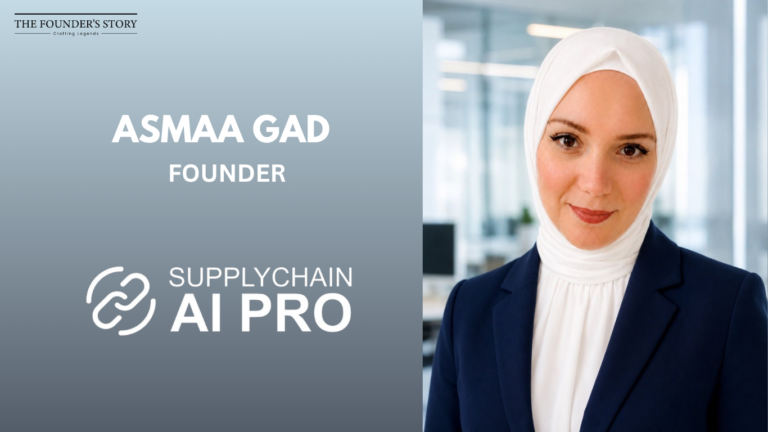
In today’s rapidly evolving business environment, Artificial Intelligence is transforming industries at an unprecedented pace. However, for procurement and supply chain professionals, navigating the AI landscape remains a significant challenge. While countless technology providers promote AI-powered solutions, practical guidance tailored to the needs of supply chain practitioners often remains difficult to find.
This challenge inspired entrepreneur and founder Asmaa Gad to establish Supply Chain AI Pro, a platform dedicated to helping procurement and supply chain professionals understand, adopt, and apply AI in practical and meaningful ways. Rather than focusing solely on technology, the company concentrates on building knowledge, capability, and confidence through actionable frameworks, templates, playbooks, and educational resources.
Asmaa’s founder story is one of reinvention, continuous learning, and entrepreneurial vision. After returning from a career break, she recognized a significant gap in the market. Procurement professionals wanted practical AI guidance, yet much of the available information was either overly technical, heavily theoretical, or focused on product marketing. Instead of waiting for someone else to solve the problem, she decided to build the solution herself.
Today, Supply Chain AI Pro is helping professionals move beyond AI hype and toward real business value. In this exclusive founder interview, Asmaa Gad shares her entrepreneurial journey, lessons learned, perspectives on AI adoption, and her vision for the future of procurement and supply chain transformation.
TFS: Asmaa, welcome, and thank you for joining us today. We are excited to learn more about your founder journey and the vision behind Supply Chain AI Pro.
Asmaa Gad: Thank you for having me. It is a pleasure to be here and share my story. I am also excited to discuss how AI is reshaping procurement and supply chain management and why practical adoption matters more than ever.
TFS: Most founders can point to a single inflection point where everything changed. What was the moment you stopped being a professional in supply chain—and started thinking like a builder of systems and companies?
Asmaa Gad: For me, the turning point did not come from a major success or breakthrough. Instead, it came from a problem I experienced firsthand. After taking a career break to focus on my family, I returned in early 2025 determined to understand how AI could support procurement and supply chain professionals.
As I researched the market, I quickly realized that most available content was either too technical, too theoretical, or heavily focused on vendor marketing. There was very little practical guidance for professionals who wanted to apply AI in their daily work.
Initially, I searched for the resources I wished existed. However, after repeatedly coming up empty, I decided to create them myself. I started publishing LinkedIn posts, practical guides, templates, and implementation frameworks. As professionals began engaging with the content and sharing their challenges, I realized the need was much larger than I had anticipated.
That was the moment my mindset changed. I stopped thinking only about returning to the profession and started thinking about building something that could solve a widespread industry problem. That realization ultimately became the foundation of Supply Chain AI Pro.
TFS: You operate at the intersection of AI and supply chain—two domains that evolve at very different speeds. What personal experience made you confident you could bridge that gap meaningfully?
Asmaa Gad: My career path has never been linear, and I believe that has been one of my greatest strengths. I originally studied architecture before later pursuing geospatial engineering, where I worked extensively with data, systems, analytics, mapping technologies, and programming concepts.
Architecture taught me how to think structurally and solve complex problems. Geospatial engineering taught me how data flows through systems and how information supports decision-making. Interestingly, both AI and supply chain management require those same skills.
As a result, I never viewed AI as simply a technology trend. Instead, I viewed it as a system. I wanted to understand what data enters the process, what decisions need improvement, and how workflows can be redesigned more effectively.
Additionally, because I did not follow a traditional procurement path, I often found myself translating technical concepts into practical language. Over time, that became a significant advantage because professionals need clarity rather than complexity. This ability to bridge technical innovation and business practicality gave me confidence that I could contribute meaningfully to the industry.
TFS: Looking back at your early career, which belief about procurement or supply chain turned out to be completely wrong—and how did correcting it shape what you’re building today?
Asmaa Gad: One belief I had to completely unlearn was that procurement and supply chain professionals already had enough practical AI resources available to them.
When I first returned to the industry, I assumed the gap was personal. I thought I simply needed to catch up after my career break. However, the more I researched, the more I realized that the gap existed across the entire profession.
There was no shortage of content. However, much of it lacked practical application. Professionals were being told what AI could do, but very few resources explained how to apply it within real procurement workflows.
That realization became the foundation of Supply Chain AI Pro. I understood that professionals did not need more theory. They needed templates, frameworks, playbooks, and practical examples that could help them take immediate action.
Today, everything we create focuses on usability. I want professionals to finish reading a resource and immediately know how they can apply it within their organization.
TFS: Founders often talk about “vision,” but rarely about doubt. What’s a period where you seriously questioned whether this venture should exist—and what pulled you through?
Asmaa Gad: The greatest doubt came during the early stages of building the business. Returning from a long career break already required rebuilding confidence. At the same time, I was entering one of the fastest-moving technology spaces in the world.
There were moments when I questioned whether the market would take me seriously. I wondered whether I was arriving too late or whether larger organizations would dominate the conversation around AI adoption.
What kept me moving forward was not a single breakthrough moment. Instead, it was a series of small signals. Someone would comment that a framework helped them solve a problem. Someone else would request a template. Others would reach out and describe challenges that mirrored the exact issues I was addressing.
Those interactions validated the need. They showed me that the problem was real and that professionals were actively looking for practical guidance. Those small moments gradually transformed uncertainty into conviction.
TFS: If someone studied your career decisions as a dataset, what pattern or algorithm would they discover behind how you choose what to pursue?
Asmaa Gad: At first glance, my career path may appear unconventional. It spans architecture, geospatial engineering, data analysis, a career break, and eventually AI for procurement and supply chain management.
However, there is a consistent pattern underneath it all. I am naturally drawn to systems. I enjoy understanding how different elements connect, where inefficiencies exist, and how processes can be improved.
Rather than focusing on specific job titles, I have always been interested in understanding how things work. I enjoy exploring the relationships between people, processes, technology, and data.
In many ways, Supply Chain AI Pro represents the convergence of everything I have learned throughout my career. It combines systems thinking, education, data, communication, and practical problem-solving into one entrepreneurial venture.
TFS: In a space crowded with AI claims, what is the one capability SupplyChainAIPro is deliberately not building—and why is that restraint strategically important?
Asmaa Gad: We have intentionally chosen not to become a transactional procurement software platform. We are not building ERP systems, sourcing platforms, or procurement transaction engines.
This decision is strategic because the market already offers numerous technology solutions. However, many organizations still struggle with capability development, workflow redesign, and practical AI adoption.
Our focus is helping professionals understand how to use technology effectively. We provide education, implementation frameworks, AI roadmaps, and practical support that enable teams to maximize value from the tools they already have.
That restraint keeps us focused on our core mission. Rather than competing with existing platforms, we help organizations become more effective users of technology and more informed decision-makers.
TFS: Many companies automate workflows, but few redefine them. Where have you intentionally redesigned the procurement or supply chain process rather than just optimizing it?
Asmaa Gad: One area where we focus heavily is changing how decisions are made rather than simply accelerating existing processes.
For example, a contract leakage tracker should do more than speed up auditing activities. Ideally, it should help contract owners identify issues before those issues become costly problems. This shifts decision-making earlier in the process.
Similarly, when evaluating AI vendors, many organizations ask broad questions about capabilities. Through our frameworks, we encourage teams to focus on evidence, measurable outcomes, and proven results.
That shift fundamentally changes the conversation. Instead of asking vendors what they claim to do, organizations begin asking what they have actually achieved. This creates better decisions and stronger outcomes.
TFS: When dealing with areas like should-cost modeling or supplier risk, accuracy and trust are everything. How do you make clients trust AI-driven decisions that even experienced professionals sometimes struggle to validate?
Asmaa Gad: Trust should never be based on blind confidence in AI. Instead, trust must be built through transparency, validation, and accountability.
When AI produces recommendations, users need to understand where the data came from, what assumptions were made, and how conclusions were reached. Without that visibility, trust becomes difficult.
I also strongly believe that human expertise must remain part of the decision process. AI should support professionals rather than replace them, especially in high-stakes areas such as supplier risk management or should-cost analysis.
The goal is not to remove judgment. The goal is to provide better information that helps professionals make more informed decisions.
TFS: AI in supply chain often promises efficiency—but efficiency can sometimes erode strategic thinking. How do you ensure your solutions don’t “dumb down” decision-making for procurement teams?
Asmaa Gad: This is a topic I care deeply about because procurement is fundamentally a strategic function.
Our approach always starts with business logic rather than AI prompts. We teach professionals how to evaluate suppliers, assess risks, structure negotiations, and define value before introducing AI tools.
AI can help organize information, generate insights, identify patterns, and accelerate analysis. However, the professional must continue to own the final judgment.
When AI removes repetitive work, professionals gain more time for strategic thinking. That is where the true value lies. AI should elevate expertise rather than replace it.
TFS: What does your internal decision-making framework look like when choosing between building a feature versus doubling down on a core capability?
Asmaa Gad: I evaluate opportunities through three primary lenses: frequency, impact, and trust.
First, I ask whether the problem occurs frequently enough to justify investment. Second, I assess whether solving it creates meaningful business value. Third, I consider whether users can understand and trust the output.
Features can be impressive, but capabilities create lasting value. I prefer investing in foundational capabilities that improve multiple workflows rather than isolated features that solve only one problem.
That approach helps ensure long-term scalability and relevance.
TFS: What’s a strategic decision you made that looked right on paper—but failed in execution—and what did it reveal about the reality of AI adoption in enterprises?
Asmaa Gad: One lesson I learned was that comprehensive solutions are not always the best starting point.
Initially, I wanted to provide complete frameworks and detailed roadmaps because procurement transformation is complex. On paper, that seemed logical.
However, many professionals felt overwhelmed by the amount of information. They understood the vision but struggled to identify where to begin.
That experience taught me that successful AI adoption often starts with small wins. Organizations gain confidence through simple use cases, practical workflows, and measurable outcomes. Once trust develops, broader transformation becomes much easier.
TFS: In implementing automation across functions like invoice processing or demand planning, where have you faced the most resistance—and what did that teach you about human behavior in transformation projects?
Asmaa Gad: The greatest resistance rarely comes from technology itself. Instead, it comes from human concerns about control, expertise, and job security.
Many professionals worry that automation will reduce the value of their experience or expose weaknesses in existing processes. Others fear losing visibility into decisions they previously controlled.
These reactions taught me that transformation is fundamentally a people challenge. Successful adoption requires trust, communication, and involvement.
When people understand that AI is designed to support their expertise rather than replace it, resistance typically decreases and engagement increases.
TFS: Founders often underestimate the cost of being early. Where has being ahead of the market hurt you—and how did you recalibrate timing without diluting vision?
Asmaa Gad: Being early can create challenges because organizations may agree with the vision while still lacking readiness to act.
Early in my journey, I often discussed advanced concepts such as AI copilots, autonomous workflows, and intelligent procurement ecosystems. While these ideas generated excitement, they sometimes felt too distant from the realities many organizations faced.
Over time, I learned to connect long-term vision with short-term action. Today, I focus on practical first steps such as improving data quality, creating prompt libraries, or testing individual use cases.
The vision remained the same. However, I became better at building a bridge between today’s reality and tomorrow’s possibilities.
TFS: If you had to remove AI entirely from your business tomorrow, what would still remain valuable—and what would that reveal about whether your company is truly “AI-first” or just “AI-enabled”?
Asmaa Gad: The most valuable assets would remain intact. Our frameworks, educational programs, implementation methodologies, templates, and community would continue to deliver value.
AI certainly provides speed, scale, and efficiency. However, our core mission is helping procurement and supply chain professionals think more effectively and make better decisions.
That distinction is important. We are not defined solely by technology. We are defined by capability building.
In that sense, Supply Chain AI Pro is AI-enabled rather than AI-dependent. Technology enhances our impact, but it is not the sole source of our value.
TFS: Imagine a future where procurement is almost fully autonomous. What role do you think humans will still irrationally insist on holding onto—and why?
Asmaa Gad: I believe humans will continue to play a critical role in supplier relationships, strategic negotiations, and complex decision-making. Those responsibilities require trust, context, empathy, and long-term relationship management.
However, organizations may continue holding onto excessive approval processes long after technology can handle routine decisions more effectively.
Many approval layers exist because they create a sense of control. Yet, in many cases, they add little value while slowing business operations.
The challenge for future procurement teams will be distinguishing between genuine judgment and procedural control. Humans should continue owning strategic judgment. However, they must become comfortable letting go of activities that no longer improve outcomes.
That balance will define the next generation of procurement leadership.
TFS: Asmaa, thank you for sharing your remarkable founder story and entrepreneurial journey. Your insights into AI adoption, procurement transformation, and supply chain innovation provide valuable lessons for business leaders, startup founders, and professionals navigating this period of technological change.
Asmaa Gad: Thank you. It has been a wonderful conversation. My hope is that professionals approach AI with curiosity and practicality. Technology alone does not create transformation. People, processes, and thoughtful implementation create transformation.
For entrepreneurs and founders, I would also say that meaningful businesses often emerge from real problems. Supply Chain AI Pro began because I could not find the practical resources I needed. Sometimes the opportunity is hidden within your own challenge.
Most importantly, continue learning, stay adaptable, and focus on creating genuine value. Those principles remain timeless regardless of how technology evolves.
TFS:Thank you once again, Asmaa. We wish you and Supply Chain AI Pro continued success as you help shape the future of procurement and supply chain excellence.
Asmaa Gad: Thank you. It has been a pleasure sharing my journey.