
The Founder’s Story | Jennifer Alexis Gavin: Where AI Amplifies Human Potential and Redefines Corporate Purpose
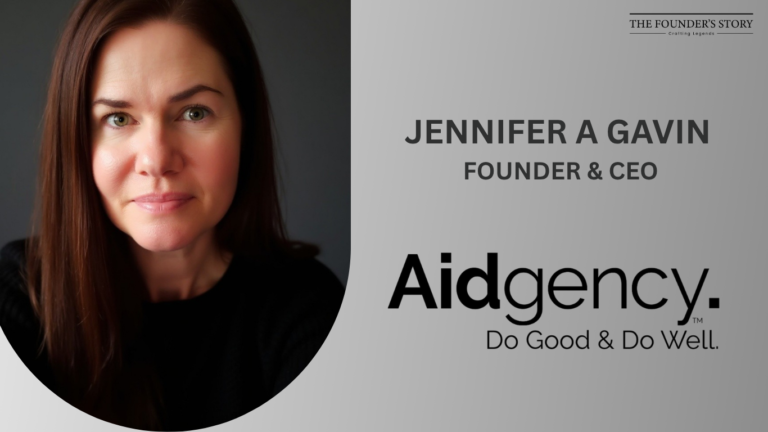
Artificial Intelligence is rapidly changing how organisations work, innovate and create value. However, Jennifer Alexis Gavin believes the technology can also help companies create meaningful social impact. As Founder and CEO of Aidgency, Jennifer is building what the company describes as an AI-powered operating system for corporate purpose.
Jennifer brings more than two decades of experience across brand, business, creativity and purpose. Moreover, she co-founded Aidgency with longtime colleague Brian Riemer, combining strategy and creative expertise developed through work with major global brands.
Aidgency is designed to connect companies, employees and nonprofits through structured impact projects. Instead of treating corporate purpose as occasional volunteering or philanthropy, the startup aims to make impact measurable, repeatable and connected to business value. Its philosophy, “Do Good & Do Well,” reflects a belief that social impact and business performance can strengthen each other.
In this exclusive Founder interview with The Founder’s Story, Jennifer Alexis Gavin shares the story behind Aidgency, explains her vision for “AI for HumanKind,” and explores how technology can extend human capability while helping companies and nonprofits create measurable impact.
TFS: Jennifer, welcome to The Founder’s Story. It is a pleasure to have you with us. How are you today?
Jennifer Alexis Gavin: Thank you. I’m delighted to be here. It is always exciting to talk about what we are building with Aidgency because the idea sits at the intersection of several things I care deeply about: creativity, business, technology, people and purpose. We are still early in the journey, so there is also a great deal we are learning. However, that makes the conversation even more valuable because we are building the model in real time with companies and nonprofits. Aidgency is ultimately about creating a better way for organisations to use their resources, people and technology to create meaningful impact. At the same time, we want that impact to strengthen the organisations themselves. That is why our philosophy is simple: Do Good & Do Well.
TFS: “AI for HumanKind” is a striking reframe of a term usually reserved for humanitarian tech. Walk us through the moment that phrase clicked for you — what were you reacting against?
Jennifer Alexis Gavin: I would slightly reframe the premise because we were not reacting against something specific. Instead, “AI for HumanKind” reflects what we believe AI should become. Technology should amplify human potential, creativity and impact. Too often, the AI conversation focuses on what technology might replace. However, we are much more interested in what it can enable people to accomplish. AI can remove repetitive work, accelerate research, organise information and help people make better decisions. Therefore, the question becomes how we use those capabilities responsibly. At Aidgency, we want AI to create more capacity for people to collaborate, solve problems and create positive change. That is especially important in the nonprofit and corporate purpose space. Ultimately, AI should not make people less human. Instead, it should give people more time and capability to do the work that only humans can do.
TFS: Aidgency treats impact as business strategy, not philanthropy. What’s the single most common objection you hear from a CFO or board member when you make that pitch and how do you counter it?
Jennifer Alexis Gavin: The most common objection is usually, “We already do this.” Companies often point to volunteer days, charitable contributions or pro bono projects. Those initiatives are valuable, but they typically operate as individual programmes rather than as a measurable business strategy. Therefore, we help companies look at the broader value that impact can create. That includes stronger brand equity, employee engagement, leadership development, reputation, innovation and organisational learning. Moreover, there is an important ecosystem opportunity. No individual company can create the scale of change required on its own. Aidgency measures impact at both the company and ecosystem levels, so organisations can understand what works and where collaboration can create more value. We also see impact as an entry point for AI adoption. Employees can build AI confidence while working on meaningful projects. Consequently, impact becomes a business growth engine rather than a side initiative.
TFS: You describe this as “not a simulation or a marketing campaign — a working model.” What’s one uncomfortable thing you learned once real dollars and real nonprofits were on the line that no amount of planning could have prepared you for?
Jennifer Alexis Gavin: We are still in pilot mode, so we are learning directly from companies and nonprofits in real time. However, one lesson has already surprised us. The hardest part is not the technology. It is the human side. AI is evolving incredibly quickly, so we continually adapt the platform to take advantage of new capabilities. Yet technology alone does not create impact. The model works only when it meets people where they are. Companies, employees and nonprofits have different needs, expectations and comfort levels with new technology. Therefore, trust and relationships matter as much as the platform itself. We have learned that an AI-powered impact platform needs strong ecosystem design, thoughtful facilitation and genuine collaboration. Ultimately, our goal is not simply to use AI. Instead, we want to use AI in ways that help people work together and create meaningful change.
TFS: Corporate purpose has traditionally lived in comms and CSR departments — often the first budget cut in a downturn. How does Aidgency’s “operating system” framing move purpose out of that seasonal, symbolic bucket and into something a company can’t easily strip out?
Jennifer Alexis Gavin: We describe Aidgency as an operating system because purpose should not depend on a single programme or budget line. Instead, it should become part of how a company operates. Aidgency connects impact with employee engagement, leadership development, reputation, innovation and organisational learning. Moreover, each project contributes to a connected ecosystem where progress can be tracked and measured. Companies receive reporting that demonstrates the impact created, the engagement generated and the value delivered. Therefore, purpose becomes measurable rather than symbolic. When companies view purpose only as philanthropy, it can become vulnerable during difficult economic periods. However, when purpose helps organisations develop leaders, retain employees, strengthen reputation and create measurable value, it becomes much harder to separate from business strategy. The question changes from “What are we doing for purpose?” to “How is purpose helping us build a stronger organisation?”
TFS: You talk about AI extending human capacity rather than replacing it. In the specific context of nonprofit and CSR work, where’s the line you won’t let AI cross — a task you deliberately keep human?
Jennifer Alexis Gavin: The line we will not let AI cross is replacing the human collaboration that creates meaningful impact. AI can accelerate research, organise information, identify patterns and support teams throughout a project. However, the deeper value comes from relationships between companies and nonprofits. Trust, conversation, empathy and collective creativity remain fundamentally human. Therefore, we deliberately design the experience around meaningful collaboration. For example, teams need structured exercises, clear objectives, appropriate timeframes, breaks and thoughtful facilitation. Those details help people contribute their best thinking. AI can support that process, but it cannot replace the shared experience that makes collaboration meaningful. Whether the work happens virtually or in person, human connection remains essential. Ultimately, AI should extend human capacity rather than diminish it. That principle sits at the heart of our AI for HumanKind philosophy and shapes how we think about every Aidgency experience.
TFS: If purpose work becomes “repeatable, measurable and scalable,” what’s the actual metric you use to prove it’s working — the one number a skeptical executive would trust over a glossy impact report?
Jennifer Alexis Gavin: Because we are still in pilot mode, we are being deliberate about validating the right metrics rather than forcing one number too early. Traditionally, companies have measured purpose through activities such as volunteer hours, donations or projects completed. However, those figures do not capture the full value created. Aidgency is building infrastructure that can measure outcomes for nonprofits, employees and companies. Each project generates data that helps us understand what worked and where improvements are needed. Therefore, we want to move from measuring activity to measuring value. The long-term question is not simply, “How much did we do?” Instead, it is, “What changed because we did it?” That includes nonprofit outcomes, employee engagement, leadership development and business value. Ultimately, the strongest metric will show whether impact can become a capability that organisations continuously measure, improve and scale.
TFS: You’re asking companies to treat equity and employee engagement as outcomes of purpose work, not just PR. What does a company get wrong first when it tries to do this itself, without a platform like Aidgency?
Jennifer Alexis Gavin: The first mistake is treating purpose as a programme rather than a business capability. Most organisations have good intentions. They support nonprofits, sponsor volunteer activities and encourage employees to participate. However, those activities can remain disconnected from leadership development, employee engagement, innovation and measurable outcomes. The second challenge is assuming collaboration will happen naturally. It usually does not. Meaningful collaboration between a company and a nonprofit requires thoughtful design, facilitation and trust. Finally, organisations often measure activity rather than impact. They may know how many people volunteered or how much money they donated, but they may not know what changed for employees, nonprofits or the business. Therefore, Aidgency connects those elements. We provide structure, measurement and an ecosystem that helps transform purpose from well-intentioned activity into a repeatable capability that creates value for everyone involved.
TFS: Nonprofits are often wary of corporate partners treating them as a checkbox. How did you design Aidgency to make the nonprofit side feel like a genuine beneficiary of the model rather than a supplier to it?
Jennifer Alexis Gavin: It starts with changing how we view the nonprofit sector. Too often, nonprofits are viewed primarily through the lens of charity. However, they are also an important part of the economy and community infrastructure. In the United States alone, the nonprofit sector contributes significant economic value and employs millions of people. Therefore, when the sector struggles, the effects extend beyond individual organisations. That perspective influenced how we designed Aidgency. Nonprofits are not suppliers to corporate purpose programmes and they are not simply recipients of generosity. Instead, they are partners in creating value. Every engagement should generate meaningful outcomes for both sides. Moreover, our measurement framework reflects that principle. We ask not only what the company contributed, but also what value the entire ecosystem created. Ultimately, treating nonprofits as strategic partners leads to stronger relationships, better outcomes and more meaningful long-term impact.
TFS: You’re currently building toward a pilot. What does success look like at the end of that pilot — concretely, what changes for a sponsoring company that wasn’t true before?
Jennifer Alexis Gavin: Success means leaving the pilot with credible evidence rather than assumptions. By the end of the pilot, we want to understand whether the Aidgency operating model creates measurable value for companies, employees and nonprofits. Moreover, we will have tested the framework in real-world conditions and refined it based on what we learn. We also expect to develop a stronger data layer that can guide the platform as it grows. Another important outcome will be independent research into how employees across industries view the intersection of purpose, AI and work. That represents a genuine white space, so we want to contribute useful knowledge rather than simply make marketing claims. Therefore, we intend to share what worked and what did not. Ultimately, category-defining businesses need evidence. If the pilot demonstrates measurable value, it gives companies confidence to move from experimentation toward a scalable operating model.
TFS: Every founder building “infrastructure” claims they’re setting a new standard. What existing standard, framework or industry norm are you most explicitly trying to displace or make obsolete?
Jennifer Alexis Gavin: We are not trying to make CSR obsolete. Instead, we want to make the traditional way of operationalising CSR obsolete. For decades, corporate purpose has often existed through volunteer days, charitable giving, annual reports and individual programmes. Those efforts can create value, but they frequently focus on activity rather than outcomes. We believe purpose should function as an operating capability. Therefore, it should connect with leadership development, employee engagement, technology adoption, innovation and measurable value creation. We are also challenging another assumption. Nonprofits should not be treated simply as beneficiaries of corporate generosity. They are vital economic and community partners. If Aidgency succeeds, the question will change. Companies will stop asking only, “What is our CSR strategy?” Instead, they will ask, “How does purpose help us build a stronger organisation while strengthening the ecosystem around us?” That is the standard we want to create.
TFS: How much of Aidgency’s model depends on the AI layer being genuinely novel versus the real innovation being the operating discipline you’re imposing on a messy, unstructured space?
Jennifer Alexis Gavin: The AI layer is important, but it is not the entire innovation. The bigger opportunity is creating infrastructure around it. Corporate purpose has historically been fragmented and difficult to measure. It also depends heavily on individual relationships and isolated programmes. Aidgency brings operating discipline to that environment by creating a structured ecosystem where companies and nonprofits can collaborate through a repeatable framework. Moreover, every engagement contributes to a growing data layer. Over time, that database can reveal what works, what creates meaningful outcomes and how organisations can collaborate more effectively. AI then helps the system scale through intake, facilitation, reporting and continuous learning. Therefore, we are not building another AI tool simply for the sake of technology. We are building the operating infrastructure that allows companies and nonprofits to create repeatable, measurable impact together. AI makes that infrastructure more intelligent, scalable and useful.
TFS: You’ve chosen “Do Good & Do Well” as a shared value proposition rather than picking one side. When those two genuinely conflict in a real engagement, which one wins and who makes that call?
Jennifer Alexis Gavin: Our tagline, “Do Good & Do Well,” makes a clear statement about how we see the future. Companies should not have to choose between meaningful impact and measurable results. Traditionally, purpose and performance have often been treated as separate conversations. Doing good could be viewed as a cost, while business performance could be pursued without considering broader impact. We believe that separation is outdated. Therefore, when a genuine conflict appears, we do not see the answer as choosing one side automatically. Instead, we ask whether the engagement has been designed correctly to create value for both. That requires transparency, good measurement and honest conversations about trade-offs. Ultimately, the strongest companies will recognise that impact can strengthen performance. The future is not about balancing two competing priorities. Instead, it is about building organisations where doing good and doing well reinforce each other.
TFS: What’s a company you’d love to work with that you think is completely wrong about how it approaches corporate purpose today — and what would you tell them if they were sitting across from you right now?
Jennifer Alexis Gavin: The answer is actually twofold: Walmart and Accenture Song. Together, they represent two different dimensions of the opportunity I see for corporate purpose. Walmart demonstrates the enormous scale at which purpose can matter. When a company influences millions of employees, customers, suppliers and communities, purpose cannot simply exist as a collection of commitments. Instead, it needs to become part of how the organisation creates value, makes decisions and innovates. Accenture Song represents another opportunity because it sits at the intersection of creativity, technology and business transformation. Therefore, I would tell both organisations that the next evolution of corporate purpose is operationalisation. Companies need to move beyond communicating purpose and start connecting it with measurable outcomes and long-term value. Ultimately, purpose and performance should not compete. They should become part of the same business conversation.
TFS: Building something this category-defining usually means explaining it badly a hundred times before you explain it well once. What’s the worst version of your pitch you’ve ever given and what did it teach you?
Jennifer Alexis Gavin: Definitely the earliest versions. In hindsight, those pitches reflected how ambitious the original vision was. We initially created a business model that deliberately bridged nonprofit and for-profit worlds. We also developed a visual framework to explain how those pieces connected. It was creative, but it became too complicated. Instead of creating clarity, the framework sometimes distracted people from the core problem. Therefore, those early conversations forced us to simplify. We went back to the fundamental questions: What value are we creating? What does the market actually need? How can we explain the opportunity clearly? That process taught me an important founder lesson. Complexity is not the same as sophistication. Even category-defining ideas need a simple entry point. People must quickly understand the problem, the solution and why it matters. Once they understand those elements, they can begin to appreciate the larger vision.
TFS: Three years from now, if Aidgency has genuinely succeeded, what does a Fortune 500 sustainability or CSR job description look like that it doesn’t look like today?
Jennifer Alexis Gavin: I hope the role becomes much broader. Today, many corporate purpose leaders focus on creating programmes, managing commitments and producing reports. Those responsibilities will remain important, but the future role should also involve connecting organisations, sharing intelligence and participating in a wider ecosystem. Therefore, the CSR leader of the future should become a connector, collaborator and strategist. They should understand how purpose can influence employee engagement, leadership development, technology adoption, innovation and long-term business resilience. Moreover, companies should be able to see patterns across their own work and the broader ecosystem. That visibility can help them identify opportunities for greater impact. Ultimately, the purpose leader should not be responsible only for what the company does internally. They should also understand how the company contributes to something larger. That is the shift Aidgency is building toward: enabling organisations to Do Good & Do Well.
TFS: If someone reading this interview runs a company and does nothing else after finishing it, what’s the one action you want them to take this week?
Jennifer Alexis Gavin: I would ask leaders to challenge how they define their company’s role in purpose. Instead of looking only at the programmes your organisation already funds, look at the wider ecosystem around the issues you care about. Ask whether your company is simply supporting individual initiatives or helping strengthen the organisations and systems that make those initiatives possible. There are millions of nonprofits doing critical work, yet many still lack the infrastructure, capacity, technology and resources needed to scale. Therefore, companies have an opportunity to contribute far beyond individual donations. They can share expertise, technology, people, data and influence. Most importantly, they can build stronger partnerships. Purpose should not be something a company owns as a programme. Instead, it should become a way of participating in something larger. That is ultimately the future we want Aidgency to help build.
TFS: Jennifer, this has been a fascinating conversation. Your vision for Aidgency clearly goes beyond creating another AI startup. You are trying to rethink how companies, employees and nonprofits work together to create measurable impact.
Jennifer Alexis Gavin: Thank you. That is exactly what we are trying to do. We are still early and therefore there is a lot left to learn. However, I believe the opportunity is significant because companies are already looking for better ways to create value, employees want meaningful work and nonprofits need stronger infrastructure. AI can help connect those needs when we use it thoughtfully.
TFS: And finally, what would you like readers to remember about your Founder story and the journey ahead?
Jennifer Alexis Gavin: I would like them to remember that purpose does not have to sit outside business. It can become part of how a company grows, learns, innovates and creates value. At Aidgency, we believe technology should help people do more, not simply replace what they already do. So, if we can help companies and nonprofits work together more effectively, while creating measurable value for everyone involved, then we will have built something worthwhile.
TFS: Jennifer, thank you for sharing your entrepreneurial journey, your perspective on AI and the story behind Aidgency. We wish you and the entire team every success as you continue building this new model for corporate purpose.
Jennifer Alexis Gavin: Thank you. It has been a pleasure and I appreciate the opportunity to share what we are building. The journey is only beginning, but I am excited about where it can lead.