
The Founder’s Story | Joselina Peralta: Turning Strategy into Sustainable Enterprise Execution
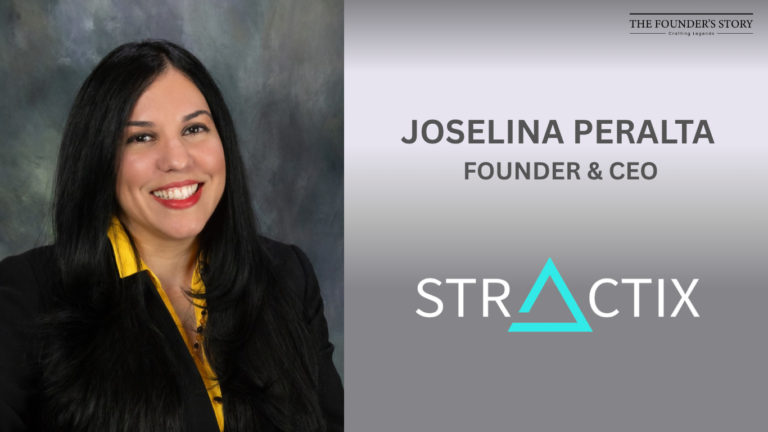
Joselina Peralta is an executive operator, entrepreneur and Founder of STRACTIX®️, a practitioner-led advisory firm helping executive teams identify and resolve the conditions putting enterprise outcomes at risk. Having carried the accountability of the CPO, CSCO and COO seats, led 20+ enterprise transformations and delivered more than $100M in measurable OpEx impact, she built STRACTIX to intervene while the outcome is still changeable, before execution failure hits the P&L.
Rather than treating execution as the final stage of strategy, Joselina believes execution begins much earlier. Therefore, her Founder story centers on a powerful idea: organizations must address the conditions that shape performance before those conditions become financial, operational, or strategic consequences. STRACTIX® brings this philosophy to life by combining executive insight, operating-model thinking, transformation expertise, and practical execution discipline.
TFS: Joselina, welcome to The Founder’s Story. It is a pleasure to have you with us. STRACTIX has a particularly interesting perspective on strategy and execution. Before we explore your entrepreneurial journey, thank you for joining us.
Joselina Peralta: Thank you. I’m delighted to be here. I’m also looking forward to sharing the story behind STRACTIX and some of the lessons I’ve learned across procurement, supply chain, operations, and executive leadership.
TFS: STRACTIX focuses strongly on enterprise execution. What inspired you to build a company around this particular challenge?
Joselina: The inspiration came from years of seeing the same pattern across organizations. Businesses often have talented people, strong strategies, sophisticated technology, and access to enormous amounts of data. Yet, they can still struggle to turn those advantages into sustained enterprise performance.
That experience shaped the STRACTIX story. I wanted to build the partner I wished I had when I was sitting in the seat of a CPO, CSCO, and COO. The challenge was rarely a lack of strategy or technology. Instead, the challenge was translating executive intent into coordinated action while the business continued to operate.
Therefore, STRACTIX® exists to close the gap between strategic intent and execution. We help leaders identify the conditions shaping performance, address unresolved trade-offs, and stay close to execution until results actually stick.
TFS: Your career has spanned procurement, supply chain, operations, and executive leadership. Looking back, what were the pivotal moments that shaped your leadership philosophy?
Joselina: Three moments shaped how I lead today. First, I learned that a business can appear healthy while depending on extraordinary intervention to keep operating. Production runs, customers receive service, and dashboards look healthy. However, leaders repeatedly resolve the same decisions while teams compensate for conflicting priorities. That taught me to ask what the organization has become exceptionally good at compensating for.
Second, moving across procurement, supply chain, operations, and transformation showed me that enterprise outcomes rarely come from one function alone. Instead, they emerge through the handoffs and unresolved trade-offs between functions.
Finally, executive accountability changed my definition of leadership. Leadership is not about having the best answer. Rather, it is about creating the conditions for the enterprise to make the right trade-offs, coordinate action, and sustain performance without constant executive intervention.
TFS: Every successful leader has faced defining challenges. Can you share a moment that tested you professionally and how it influenced the leader you are today?
Joselina: One defining period involved a business where the visible problem was performance. However, the real constraint was structural. The organization had become highly skilled at recovering. Teams worked harder, leaders stepped in, and short-term commitments remained protected. Yet every recovery quietly consumed capacity, credibility, and margin.
The real test was resisting the pressure to treat every symptom as an isolated issue. A quick fix might have protected the immediate outcome. However, it would also have reinforced the conditions creating the problem.
Therefore, we made hidden trade-offs explicit, clarified ownership, and redesigned how decisions moved across functions. That experience taught me something fundamental about leadership. Execution failure rarely starts during execution. Instead, it starts earlier when partially resolved decisions, fragmented accountability, and misaligned incentives become normal. Real leadership means exposing that operating reality before financial consequences force the conversation.
TFS: Before founding STRACTIX, what was the biggest lesson you learned from working in global organizations that still guides your decisions today?
Joselina: The biggest lesson was that intelligence does not automatically become enterprise outcomes. Global organizations rarely lack expertise, data, technology, or strategic ambition. Instead, they struggle because context becomes fragmented, trade-offs remain unresolved, and accountability spreads so widely that nobody owns the enterprise consequence.
I saw highly capable teams make individually rational decisions that collectively weakened performance. Demand wanted availability, while Finance wanted lower working capital. Procurement wanted cost reduction, whereas Operations wanted stability. Each function optimized its own objective, yet the enterprise absorbed the cost of the unresolved trade-off.
That lesson still guides my decisions today. I always ask leaders to optimize the enterprise rather than the function. Before adding another initiative, dashboard, or technology layer, I ask what must become true across the enterprise for the outcome to change. That question often reveals whether the real constraint is information, governance, the operating model, or execution.
TFS: What motivated you to leave a successful corporate career and build STRACTIX, and what problem were you determined to solve?
Joselina: I founded STRACTIX® to build the partner I wished I had when I was sitting in the seat of a CPO, CSCO, and COO. The challenge was rarely a shortage of strategy, advice, or technology. Instead, it was translating executive intent into enterprise outcomes while the business continued to operate.
Traditional consulting often ends with recommendations. Then, internal teams must reconcile competing priorities, fragmented ownership, political realities, and operational constraints while remaining accountable for the promised outcome. That is where enterprise value can quietly erode.
Therefore, STRACTIX® was created to close the gap between strategic intent and sustained execution. We help leaders identify the enterprise conditions already shaping performance, de-risk high-stakes transformations, and stay through execution until results stick.
Ultimately, our objective is simple. We want to protect enterprise value before execution failure reaches the P&L, service levels, or board confidence.
TFS: You have worked closely with CPOs, CSCOs, COOs, and CEOs. What separates organizations that consistently execute from those that are constantly stuck in transformation mode?
Joselina: Organizations that execute consistently make the enterprise consequence more important than the functional agenda. They create shared context, make assumptions explicit, clarify ownership of enterprise trade-offs, and prevent decisions from repeatedly reopening.
Organizations trapped in transformation mode often have plenty of activity. They have steering committees, workstreams, dashboards, and status meetings. However, they often lack resolution. The same constraints move between meetings, ownership shifts without accountability, and teams learn to compensate rather than eliminate the underlying cause.
Therefore, the difference comes down to execution architecture. High-performing organizations understand which decisions require enterprise ownership, where escalation belongs, and what cannot be optimized locally. They also know how to convert insight into coordinated action.
Transformation succeeds when it becomes part of how the enterprise operates. It fails when the transformation office remains permanently indispensable.
TFS: In your experience, what is the most uncomfortable truth that executive teams often need to hear but rarely discuss openly?
Joselina: The most uncomfortable truth is that many organizations are not constrained by the problems they cannot see. Instead, they are constrained by the problems they have learned to live with.
Consider the workaround everyone depends on, the recurring decision that never stays resolved, or the constraint already embedded in budgets and forecasts. Over time, these issues stop looking like problems. They simply become the normal cost of operating at scale.
However, more visibility will not solve a problem the organization has no mechanism to resolve. A dashboard can show a trade-off, while AI can predict its consequence. Neither can create ownership or coordinated execution.
Therefore, the uncomfortable work is changing the enterprise conditions that the organization has mistaken for normal. Leaders must address those conditions before they become financial consequences. By then, the cost of inaction is often much higher.
TFS: Many leaders focus on strategy. Few focus on execution. Why do you believe execution remains one of the biggest competitive advantages in business today?
Joselina: Execution remains a competitive advantage because strategy has become easier to access and harder to differentiate. Most organizations can access similar technology, talent, market intelligence, and strategic expertise. However, competitors cannot easily copy the ability to translate those inputs into coordinated action under pressure.
Execution determines whether innovation becomes revenue, procurement savings reach the P&L, AI creates measurable value, and transformation increases capability rather than complexity. Therefore, execution is the mechanism through which strategic possibility becomes economic advantage.
The advantage is not simply moving faster. Instead, it comes from resolving the right trade-offs earlier, preserving execution capacity, and building an operating model that can reproduce performance as conditions change.
Ultimately, execution is no longer the final stage of strategy. It is the capability that determines whether strategy matters at all. That is one of the central principles behind the STRACTIX Founder story.
TFS: Procurement and supply chain are increasingly being viewed as strategic functions. What are the biggest opportunities leaders are still overlooking?
Joselina: The largest opportunity is to stop treating procurement and supply chain as support functions. Instead, leaders should recognize them as enterprise infrastructure. These functions sit at the intersection of cost, innovation, working capital, growth, and external capability.
Three opportunities remain particularly underused. First, supplier ecosystems can become sources of capability, innovation, and speed rather than simply channels for negotiation. Second, procurement and supply chain can expose the enterprise trade-offs affecting margin, service, inventory, and growth before those consequences reach the P&L.
Third, these functions can orchestrate AI and data across the operating ecosystem. That approach connects intelligence to execution rather than simply adding another layer of visibility.
Ultimately, the overlooked shift is from proving procurement’s value to increasing the enterprise’s capacity to create value. That shift can fundamentally change how boards and CEOs perceive these functions.
TFS: If you joined a company tomorrow as CEO, what would be the first three indicators you would examine to assess the health of its supply chain and procurement function?
Joselina: First, I would examine where the organization is compensating. Recurring expedites, manual overrides, exception meetings, and leadership interventions can reveal where the operating model compensates for structural constraints.
Second, I would examine how the organization resolves enterprise trade-offs. Decisions involving service, inventory, cost, capacity, and supplier risk should have clear ownership and remain resolved. If the same decisions repeatedly require executive attention, the business may not have an information problem. Instead, it may have an execution or governance problem.
Third, I would trace reported value directly to the P&L. Procurement savings, productivity gains, inventory actions, and transformation benefits should become visible in margin, cash, service, and growth.
Therefore, I would focus less on functional performance alone and more on the gap between reported value and realized enterprise value. That gap often contains the most expensive exposure.
TFS: You often advocate for turning procurement and supply chain into growth engines. What practical shifts must leaders make to move beyond a cost-saving mindset?
Joselina: The first shift is from measuring activity to measuring enterprise consequence. Savings, projects, contracts, and dashboards create value only when they change margin, cash, service, growth, or strategic capacity.
Second, leaders must move from supplier management to ecosystem orchestration. Supplier ecosystems should become extensions of the enterprise operating model. Therefore, they can provide innovation, speed, scale, and capabilities that the organization cannot or should not build internally.
Third, leaders need to move from functional optimization to enterprise trade-off management. Procurement cannot optimize cost while ignoring inventory, service, quality, speed, or growth. Similarly, supply chain cannot protect availability by continually absorbing working capital and complexity.
Finally, leaders must speak in enterprise outcomes rather than functional achievements. Procurement and supply chain become genuine growth engines when they demonstrate how they protect earnings, enable strategy, and increase the organization’s ability to compete.
TFS: Every boardroom is discussing AI. In your view, where is the real value opportunity for procurement and supply chain leaders, and where is the hype?
Joselina: The real value of AI is not simply automation or faster analysis. Instead, AI can connect fragmented information, detect patterns earlier, simulate trade-offs, and improve enterprise decisions. In procurement and supply chain, that can strengthen demand sensing, supplier-risk detection, inventory decisions, working capital, capacity planning, and end-to-end orchestration.
The hype begins when organizations treat AI as a substitute for operational context, governance, or executive judgment. AI can optimize the objective it receives. However, it cannot determine whether the enterprise is optimizing the right objective.
It also cannot resolve competing functional incentives or create ownership for the resulting consequences. Technology scales what organizations have already made true. Therefore, structural problems do not disappear with better AI. They can instead become faster and more deeply embedded.
The board-level question should not be where to deploy AI. It should be which enterprise outcome must change and whether the operating conditions exist for AI to change it.
TFS: What will distinguish organizations that successfully leverage AI from those that simply invest in technology without achieving meaningful outcomes?
Joselina: The winners will distinguish between intelligence and enterprise execution. They will begin with a specific enterprise outcome, identify the decisions and constraints shaping it, and redesign the operating conditions required to act on the intelligence AI produces.
Successful organizations will have clear ownership, trusted data, explicit decision rights, cross-functional governance, and operating models designed to act on intelligence. They will also understand where human judgment remains essential and where automation can safely increase speed and scale.
Most importantly, they will measure value through margin, cash, service, risk, growth, and execution capacity rather than model usage or pilot activity.
Organizations that underperform will accumulate pilots, dashboards, and fragmented use cases while preserving the same decision latency and cross-functional friction.
Therefore, the defining advantage will be the ability to convert intelligence into coordinated enterprise action repeatedly, predictably, and at scale.
TFS: As businesses navigate geopolitical uncertainty, supply disruptions, and rapid technological change, what leadership capabilities will become most critical over the next decade?
Joselina: The first capability will be systems judgment. Leaders must see how decisions, incentives, technology, suppliers, and operating constraints interact across the enterprise rather than optimizing one function in isolation.
Second, leaders will need decision clarity under uncertainty. They must distinguish what remains reversible, what has already become embedded, and where intervention can still create disproportionate value.
Third, orchestration will become increasingly important. Competitive advantage will depend on how effectively leaders align internal functions, external partners, data, and AI around shared enterprise outcomes.
Fourth, leaders must translate complexity into decisions that others can act on. Boards, teams, suppliers, and customers require different context. However, the enterprise can execute only behind one clear direction.
Finally, leaders must protect execution capacity. The defining question will not simply be how quickly an enterprise recovers from disruption. Instead, it will be whether every disruption leaves the organization more capable than before.
TFS: What do you believe the procurement and supply chain profession will look like in 2035, and how should today’s leaders prepare for that future?
Joselina: By 2035, procurement and supply chain will be defined less by function and more by the enterprise capability they create. AI agents will manage much of the transactional flow, continuously sense risk and demand, coordinate routine decisions, and orchestrate activities across suppliers, operations, customers, and logistics ecosystems.
Meanwhile, the strategic role will expand. Procurement leaders will become architects of external capability, innovation, and capital efficiency. Supply chain leaders will orchestrate physical, digital, and commercial ecosystems rather than simply manage linear flows.
The most valuable professionals will combine commercial judgment, operational depth, AI fluency, governance, and enterprise trade-off management.
Therefore, today’s leaders should strengthen the foundations technology cannot repair. These include data standards, decision rights, supplier trust, cross-functional ownership, and operating-model clarity. They should also develop teams that challenge AI rather than simply consume its output. Technology will automate execution, but competitive advantage will come from the enterprise conditions leaders build around it.
TFS: What is a belief you hold today about leadership, business, or success that your younger self would have strongly disagreed with?
Joselina: My younger self believed strong leadership meant having the answer, moving quickly, and carrying more of the load than everyone else. Today, I believe something very different.
When an enterprise repeatedly needs a leader to integrate the work manually, the operating model is teaching the organization to depend on intervention. Therefore, leadership is not proven by how indispensable you become. Instead, it is proven by the capability that remains when you are no longer in the room.
The strongest leaders create context, clarify ownership, resolve the trade-offs only they can resolve, and build operating systems that allow the enterprise to execute without depending on them.
I also used to believe visible progress was always valuable. Experience taught me that activity can create momentum around the wrong problem. Sometimes, the highest-value decision is to slow down long enough to distinguish what is still a decision from what has already become a consequence.
TFS: If we were having this conversation ten years from now, what would need to happen for you to say, ‘STRACTIX has achieved exactly what I set out to build’?
Joselina: If we were having this conversation ten years from now, I would want STRACTIX® to have changed how executive teams think about execution.
I would want execution to be recognized as something that begins long before a transformation program launches. STRACTIX® should become the team executive operators call before high-stakes transformations begin to fail, rather than after the P&L, service levels, or board confidence reveal the damage.
Success would mean making a different standard normal. Transformations would be designed around execution reality. AI investments would be measured by enterprise outcomes rather than adoption. Procurement and supply chain would be recognized as enterprise growth infrastructure. Supplier ecosystems would accelerate innovation, speed, and scale.
Most importantly, our work would leave organizations more capable than we found them. They would become better at resolving enterprise trade-offs, coordinating decisions, and reproducing performance as conditions change.
The ultimate standard would be simple: leaders would understand that execution failure does not start during execution. It starts in the enterprise conditions that shape it.
TFS: Joselina, this has been a fascinating conversation. Your perspective on execution goes well beyond traditional consulting. You are really talking about building organizations that can perform without constantly relying on heroic intervention.
Joselina: That is exactly the goal. Organizations should not have to depend on a few individuals repeatedly solving the same structural problems. Instead, they need operating conditions that allow people, functions, technology, and partners to work together effectively.
TFS: And that seems to capture the essence of the STRACTIX story: execution is not simply about doing things faster. It is about creating the conditions that make better execution sustainable.
Joselina: Absolutely. Sustainable performance comes from the system, not from constant heroics. If STRACTIX can help leaders see those conditions earlier, make better enterprise trade-offs, and build organizations that perform without unnecessary intervention, then we will have achieved something meaningful.
TFS: Thank you, Joselina, for sharing your Founder story, leadership lessons, and vision for the future of procurement, supply chain, AI, and enterprise execution.
Joselina: Thank you. It has been a pleasure. I hope the conversation encourages leaders to look beyond the visible symptoms and ask a more important question: what conditions are shaping the outcomes we are seeing today, and what must change before those conditions become consequences?
TFS: A fitting note to close on. Thank you once again, Joselina.
Joselina: Thank you.