
The Founder’s Story | Sophia Ikhlef: Building Neia Solutions by Turning Strategy into Execution Across Europe and the GCC
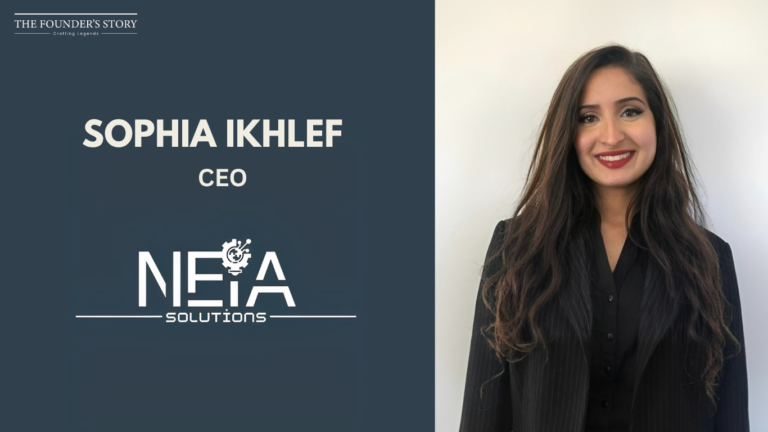
In today’s digital economy, businesses have access to countless technologies, yet many still struggle to turn ideas into meaningful results. The challenge is rarely technology itself but having the clarity and strategy to make the right decisions. Recognizing this gap, Founder and entrepreneur Sophia Ikhlef co-founded Neia Solutions as a strategic and execution partner that helps organizations transform ideas into sustainable growth.
Operating across Europe and the GCC, Neia Solutions combines business strategy, digital transformation, branding, AI innovation, institutional advisory, sports diplomacy, and technology execution. By understanding each client’s vision before recommending solutions, the company delivers practical strategies that create measurable business impact.
In this exclusive conversation with The Founder’s Story, Sophia Ikhlef shares her entrepreneurial journey, the vision behind Neia Solutions, and why strategy must always come before technology.
Sophia Ikhlef is an entrepreneur, digital transformation strategist, and Co-Founder of Neia Solutions. She has helped entrepreneurs, businesses, and public institutions drive growth through digital strategy, branding, AI, innovation, and institutional advisory across Europe and the GCC. Recognized within the Women in Tech and Women in Web3 communities, she believes technology should empower business objectives while creating lasting value.
Neia Solutions is a strategic consulting and execution company that helps startups, enterprises, and public institutions accelerate growth through digital transformation, AI, branding, institutional advisory, and business consulting. By combining strategic thinking with hands-on execution, the company enables organizations to navigate complexity and achieve sustainable business success.
TFS: Sophia, welcome to The Founder’s Story. It is a pleasure to have you with us today. Your entrepreneurial journey demonstrates how strategy, innovation, and execution can work together to create meaningful business transformation. We are excited to learn more about the story behind Neia Solutions, your vision for helping organizations grow across Europe and the GCC, and the lessons you’ve learned while building a modern strategic execution company.
Sophia Ikhlef: Thank you very much. I’m delighted to be here. It is always a pleasure to share our founder story and discuss the journey behind Neia Solutions. Every organization has unique ambitions, and I believe our role is to help leaders move from uncertainty to clarity. I’m looking forward to sharing the experiences that shaped our company and the philosophy that continues to guide everything we do.
TFS: Neia Solutions describes itself as a “strategic and execution partner,” not just a digital agency. What was the moment or frustration that convinced you the market needed that distinction?
Sophia Ikhlef: One realization shaped my entrepreneurial journey more than any other. Businesses were not struggling because they lacked technology. Instead, they struggled because they lacked clarity. Whether I was speaking with startup founders, growing businesses, large enterprises, or public institutions, I noticed the same pattern. Leaders had ambitious ideas, yet they often felt overwhelmed by technology choices, digital trends, and the fear of making expensive mistakes. Consequently, they searched for guidance rather than another software vendor.
That observation became the foundation of Neia Solutions. We decided that every conversation should begin with business strategy instead of technical specifications. Before discussing websites, platforms, Artificial Intelligence, or digital tools, we first understand the client’s objectives, challenges, and long-term vision. Sometimes the solution involves technology. Other times it requires branding, institutional advisory, business restructuring, or strategic planning.
Our philosophy remains simple. Technology should never intimidate organizations. It should create opportunities. That is why we describe ourselves as a strategic and execution partner instead of a digital agency. Success is not measured by the number of platforms we build. It is measured by the confidence we give our clients to move their businesses forward with purpose.
TFS: You and Hassène co-founded Neia, bridging Europe and the GCC — how did your personal or professional path lead you to build specifically at that intersection rather than staying in one market?
Sophia Ikhlef: Neia was built on a simple belief. Diversity creates stronger businesses. That diversity extends beyond geography because it also includes experience, leadership styles, and generational perspectives. Although Hassène and I are family, we made a conscious decision to separate our personal relationship from our professional one. Once we begin working, we become colleagues first. We challenge each other’s thinking, respect different viewpoints, and always prioritize our clients and our company above personal opinions.
Our professional backgrounds complement one another remarkably well. Hassène contributes decades of international leadership, institutional advisory, and strategic experience gained through governments, international organizations, and global sports institutions. I contribute expertise shaped by entrepreneurship, digital transformation, emerging technologies, innovation, and the expectations of a new generation of business leaders.
Building Neia Solutions between Europe and the GCC therefore became a natural evolution rather than a deliberate market choice. Together, we combine international experience with regional understanding, strategic thinking with agile execution, and established expertise with fresh perspectives. This balance enables us to support today’s decision-makers while also understanding the entrepreneurs and leaders who will shape tomorrow’s economy.
TFS: Many firms either advise or execute — Neia claims to do both end-to-end. What’s the hardest part of holding a client’s hand from strategy through delivery, and where have you seen that model tested?
Sophia Ikhlef: The most challenging part is not delivering the final solution. It is helping clients gain clarity before execution even begins. Many entrepreneurs, particularly those building businesses for the first time, arrive with exciting ideas but without a structured roadmap. They often believe they need a website, an application, or an e-commerce platform. However, after deeper conversations, we frequently discover that they first need help defining their business model, customer journey, positioning, or long-term strategy.
At that point, our relationship changes completely. We stop acting like a traditional service provider and become a trusted strategic partner. Sometimes that means challenging assumptions or recommending a completely different direction from the one initially requested. While those conversations are not always easy, they usually create the greatest long-term value.
The projects that remain closest to my heart are not necessarily the largest or the most technically sophisticated. They are the ones where clients begin feeling uncertain and finish the journey with confidence. Hearing someone say, “You’ve changed the way I see my business,” or even “You’ve changed my life,” reminds me that our startup builds far more than digital platforms. We help people gain clarity, confidence, and the courage to pursue their ambitions. That impact continues to define my founder story.
TFS: Your services span everything from e-commerce platforms to sports diplomacy to institutional advisory. How do you decide what NOT to take on, given how broad that mandate could become?
Sophia Ikhlef: People often see our services as diverse, but internally we view them through a single lens. Every project, regardless of industry, revolves around helping organizations perform better, grow sustainably, and create meaningful impact. Whether we are supporting an entrepreneur, advising a public institution, developing an e-commerce platform, or contributing to a sports diplomacy initiative, we are solving business challenges rather than selling services. That mindset keeps our focus remarkably clear.
We also avoid defining ourselves by sectors alone. Instead, we evaluate opportunities based on whether our expertise can genuinely create value. Sports, for example, teaches leadership, resilience, teamwork, discipline, and long-term thinking. Those same principles apply equally to entrepreneurship, digital transformation, innovation, and institutional development. Consequently, our knowledge transfers naturally across industries while remaining rooted in strategic execution.
At the same time, we are highly selective about the work we accept. We never pursue projects simply because they fit one of our service offerings. Before committing, we ask ourselves one important question: Can we truly help this client succeed? If the answer is uncertain, or if another specialist can deliver better outcomes, we are comfortable stepping away. Protecting trust and reputation has always mattered more than expanding our portfolio. Every project carries the Neia name, and we want that name to consistently represent quality, integrity, and meaningful results.
TFS: The SYMO project involved structuring a digital platform and marketplace across Bahrain and Abu Dhabi simultaneously — what did that cross-market build teach you about designing for two regulatory or consumer environments at once?
Sophia Ikhlef: One of the most valuable lessons was realizing that neighboring markets should never be treated as identical. Bahrain and Abu Dhabi share many regional similarities, yet they differ significantly in consumer expectations, purchasing behavior, communication styles, pricing strategies, and regulatory considerations. Assuming that one successful approach could automatically work in both markets would have been a costly mistake.
Although technology provided the digital foundation, our greatest focus remained on business strategy. We spent considerable time understanding local customer behavior, refining market positioning, adapting commercial strategies, and designing customer experiences that reflected each country’s unique realities. Consequently, the platform became far more than a technical solution because it evolved into a business model tailored for two distinct environments.
That experience reinforced an important belief we continue applying at Neia Solutions. Technology can often be replicated, but trust cannot. Every market has its own culture, expectations, and way of building relationships. Therefore, we never believe in a one-size-fits-all approach. While the technology may remain consistent, the strategy, communication, and customer experience must always respect the local market. That combination transforms digital platforms into successful businesses rather than simply functional products.
TFS: With BTCO, you integrated digital, retail and experiential components into one commercial initiative — how do you sequence a project like that so the digital layer doesn’t get built before the business model is fully validated?
Sophia Ikhlef: One of the most common misconceptions in digital transformation is believing that technology should lead the conversation. I actually believe the opposite. Technology should follow strategy, not define it. With BTCO, our first question was never, “What platform should we build?” Instead, we asked, “What business are we creating?” That shift completely changed the direction of the project.
Before discussing websites, marketplaces, or digital ecosystems, we worked closely with the client to define the value proposition, customer journey, revenue model, partnerships, target audience, and overall brand experience. Once those strategic foundations became clear, designing the technology became significantly easier because every digital decision supported a validated business model instead of trying to compensate for an undefined one.
Equally important, we wanted every customer interaction to feel connected. Whether someone discovered the brand online, visited a retail location, or attended an experiential event, the journey needed to remain seamless and consistent. Digital, physical, and experiential touchpoints were never separate initiatives. They represented different expressions of one unified strategy.
That philosophy continues to guide every project at Neia Solutions. We never build technology simply because technology exists. We build it because it enables a clearly defined business objective. When strategy leads and technology follows, organizations gain solutions that remain relevant, scalable, and capable of delivering sustainable long-term growth.
TFS: Working with institutions like the Olympic Committee and major retail groups like Landmark, how does the sales cycle and trust-building differ when your client is a public institution versus a private brand?
Sophia Ikhlef: Public institutions and private organizations certainly operate differently. However, they share one important expectation. They both look for excellence, credibility, and consistent execution. Public institutions generally have longer decision-making processes because every recommendation must align with governance frameworks, public accountability, and long-term strategic objectives. Consequently, every proposal requires greater consultation, stronger justification, and careful consideration of its wider impact.
Private companies usually move at a faster pace. They often prioritize agility, commercial performance, innovation, and measurable business outcomes. As a result, they expect strategic decisions that can quickly translate into tangible growth. Although the pace differs, our responsibility remains exactly the same. We adapt our communication, planning, and execution while maintaining the same standards of professionalism, quality, and commitment for every client.
One lesson has become increasingly clear throughout my entrepreneurial journey. Trust creates momentum. Working with respected institutions encourages us to uphold exceptionally high standards, and those standards naturally strengthen every other project we undertake. Likewise, the success we achieve with startups and growing businesses demonstrates that our methodology creates value regardless of organizational size. For us, reputation is never built by the prominence of a client. Instead, it grows through consistently delivering results, one relationship at a time.
TFS: Being Bahrain-based but “Saudi-ready” is a specific positioning — what did you have to build operationally to be genuinely execution-capable in Saudi Arabia rather than just accessible to it?
Sophia Ikhlef: Being geographically close to Saudi Arabia is relatively easy. Becoming genuinely prepared to deliver successful projects there requires a completely different level of commitment. For us, being Saudi-ready has never been about proximity. It has always been about preparation, understanding, and long-term relationship building.
From the beginning, we invested significant time in understanding the Saudi business landscape, strengthening local partnerships, learning regulatory expectations, and adapting our ways of working to match the country’s evolving market environment. We also recognized that every GCC country has its own business culture. Although Bahrain and Saudi Arabia share many similarities, decision-making styles, communication preferences, commercial expectations, and business rhythms often differ considerably.
That understanding shaped our entire execution model. Rather than exporting the same solutions from one country to another, we tailor our strategies, implementation methods, and client engagement for each market. We believe that understanding local culture is just as important as understanding technology or business processes. Relationships remain at the center of successful execution.
Ultimately, being Saudi-ready means much more than entering a new market. It means arriving with the right partnerships, the right knowledge, and the right mindset from day one. When those foundations already exist, digital transformation, branding, innovation, and strategic advisory become far more effective because they are built on trust rather than assumptions.
TFS: You’ve spoken about your recognition in Women in Tech and Women in Web3 circles — has being a woman leading a strategic execution firm in the GCC changed how you have to earn credibility in early client conversations, compared to Europe?
Sophia Ikhlef: Yes, it certainly has. My journey has shown me that credibility is built differently across cultures and industries. While recognition within the Women in Tech and Women in Web3 communities has provided valuable visibility, it has also increased my sense of responsibility. Awards may open doors, but they never replace consistent performance.
Technology and strategic advisory continue to be industries where women sometimes need to work harder to establish immediate credibility. There are still assumptions about who should lead innovation, digital transformation, or business strategy. Rather than allowing those perceptions to become obstacles, I chose to let preparation, consistency, and results speak louder than stereotypes. Over time, those qualities changed many early conversations into long-term partnerships built on trust.
However, the recognition I value most extends beyond my own career. I hope my founder story encourages more women to pursue entrepreneurship, technology, and leadership with confidence. If another woman feels inspired to launch her startup, embrace innovation, or believe she belongs in these industries because of something she has seen in my journey, then that represents a meaningful achievement. Success should never be measured only by personal milestones. It should also be measured by the opportunities we help create for others.
TFS: When a client comes to you wanting “just a website,” how do you push them toward the deeper strategic structuring work you believe they actually need, without losing the deal?
Sophia Ikhlef: I never begin by trying to expand the scope of a project. Instead, I begin by understanding the reason behind the request. Whenever a client says, “I just need a website,” my first response is always another question: “What do you want your website to achieve?” That simple question usually changes the entire conversation because it shifts the focus from technology to business objectives.
Very quickly, we stop discussing pages, colours, layouts, or features. Instead, we begin exploring the company’s vision, target audience, customer journey, competitive positioning, revenue goals, and long-term ambitions. Those conversations often reveal that the website itself is only one component of a much larger business ecosystem.
I always explain that a website should never function as a digital brochure alone. It represents the first impression many customers will have of a business. Therefore, it should reinforce the company’s brand, communicate its value proposition, generate trust, and support commercial growth. Without a clear strategic foundation, even the most visually impressive website will struggle to deliver meaningful business results.
Interestingly, clients rarely feel they are being sold additional services. Instead, they appreciate the honesty and guidance. They recognize that we are helping them solve the right problem rather than simply delivering the product they originally requested. That relationship is exactly what we strive to build at Neia Solutions. Our objective is never just to launch a website. Our mission is to help businesses succeed because a successful business always gives purpose to its digital presence.
TFS: What’s a project where the strategic advisory side of Neia completely changed the digital or event execution plan you’d originally been asked to build?
Sophia Ikhlef: One project perfectly captures how we approach every client engagement. The company initially approached us with what seemed like a straightforward request. They simply wanted a new website. Many agencies would have immediately moved into design and development. However, we believed it was important to first understand the business behind the request.
As we progressed through our discovery sessions, it became clear that the website was not the real challenge. The business had ambitious goals, but its market positioning, brand identity, communication strategy, and long-term direction had not yet been fully defined. Building a website at that stage would only have masked deeper strategic issues rather than solving them.
Together, we completely restructured the engagement. We focused first on defining the company’s value proposition, refining its branding, strengthening its market positioning, developing its communication strategy, and clarifying its long-term vision. Only after those strategic foundations were firmly established did we begin designing the digital platform.
The final outcome extended far beyond the original request. The project evolved into a complete business transformation that included a refreshed visual identity, corporate profile, social media strategy, digital presence, and commercial positioning. Looking back, I am convinced that simply delivering the requested website would have completed the assignment, but it would not have addressed the client’s actual business needs.
That experience reinforced one of the core principles behind Neia Solutions. Digital platforms should express business strategy rather than replace it. When organizations invest time in defining their purpose first, every technology decision becomes more meaningful and creates greater long-term value.
TFS: Neia positions itself as agile with direct founder involvement rather than “outsourced communication” — as you take on larger institutional mandates, how do you protect that hands-on quality without becoming the bottleneck yourself?
Sophia Ikhlef: That is a question I think about constantly because sustainable growth requires much more than increasing revenue or expanding operations. It requires protecting the values that clients trusted from the very beginning. One of the reasons organizations choose Neia Solutions is because they know they will work directly with the founders. They do not spend weeks explaining their vision before being passed through multiple departments. That direct relationship creates trust, accelerates decision-making, and ensures strategic alignment throughout the project.
However, our ambition is not to remain small. Our ambition is to remain close. Those are two very different objectives. As we continue growing, we focus on building strong internal processes, surrounding ourselves with trusted specialists, and creating multidisciplinary teams that genuinely share our standards of excellence. Every expert who joins a project represents an extension of Neia’s culture rather than simply an outsourced resource.
My own role has naturally evolved as well. Instead of participating in every operational detail, I now concentrate on the areas where I can create the greatest value. That includes understanding the client’s vision, defining strategic direction, supporting key decisions, and ensuring that every final deliverable reflects the quality and integrity associated with our brand.
For me, leadership has never meant doing everything personally. Leadership means building exceptional people who can consistently deliver excellence while preserving the trust, transparency, and personal relationships that clients associate with our company. That balance allows us to scale internationally without losing the entrepreneurial spirit that shaped our founder story from the very beginning.
TFS: Sports diplomacy and institutional advisory are unusual pillars for a digital company to house under one roof — how do those worlds actually cross-pollinate in practice, versus just sitting side by side on your services page?
Sophia Ikhlef: At first glance, they appear to belong to completely different industries. However, when you look beyond the sectors themselves, they are driven by the same leadership principles. Whether we work with a sports federation, a government institution, a startup, or a private company, we are solving similar challenges around governance, communication, stakeholder engagement, long-term strategy, and organizational performance.
Sports diplomacy has taught us lessons that extend far beyond sport. High-performing teams succeed because they embrace discipline, resilience, adaptability, collaboration, and a shared vision. Those same qualities also determine whether organizations successfully navigate digital transformation, business growth, or institutional change. Likewise, institutional advisory requires careful listening, thoughtful governance, and the ability to balance ambitious ideas with practical execution. Those experiences strengthen every digital transformation project we undertake.
Technology then becomes the natural extension of strategy rather than an isolated service. It enables organizations to bring carefully developed ideas to life. That is why our services never operate independently. Every experience informs the next. Sports enhances leadership thinking. Institutional advisory strengthens governance. Digital transformation accelerates execution. Together, they allow us to help people and organizations achieve their highest potential. That integrated philosophy continues to define the entrepreneurial story behind Neia Solutions.
TFS: AI and innovation solutions are listed among your offerings — where are GCC clients genuinely ready to adopt AI right now, versus where you’re still doing the educational groundwork first?
Sophia Ikhlef: The GCC has embraced Artificial Intelligence with remarkable ambition, and organizations across the region are moving quickly. However, readiness varies significantly depending on digital maturity, leadership vision, and business priorities. Today, we see the strongest adoption in areas where AI delivers immediate and measurable value. These include customer experience, workflow automation, operational efficiency, communication, analytics, and decision support.
At the same time, education remains one of our most important responsibilities. Many organizations understandably become excited about AI because of its enormous potential. However, some also assume it represents the answer to every business challenge. In reality, technology without strategy rarely produces sustainable results. One of the greatest risks today is not failing to adopt AI. Instead, it is implementing AI without a clearly defined purpose or measurable business objective.
That is why we encourage every client to view Artificial Intelligence as a co-pilot rather than the pilot itself. AI should strengthen human expertise, creativity, and decision-making instead of replacing them. Sometimes AI provides the right solution. Other times, improving an existing business process or refining an organizational strategy delivers greater long-term impact.
Our philosophy remains remarkably simple. AI should amplify human intelligence rather than replace it. The organizations that succeed over the next decade will not necessarily be those using the most AI. They will be the ones using AI with the clearest strategy, the strongest leadership, and the greatest understanding of where technology genuinely creates value.
TFS: If you look three years out, does Neia stay a boutique strategic-execution partner by design, or is there a version of this that scales into something larger — and what would you have to give up to get there?
Sophia Ikhlef: I have never believed that growth and personal relationships need to compete with one another. In fact, I believe they should strengthen each other. Over the next three years, I absolutely expect Neia Solutions to expand internationally while building stronger partnerships across new markets. Our ambitions are global because we believe organizations everywhere deserve strategic partners who combine clarity with execution.
However, one principle will never change. We will always remain a strategic partner before becoming a service provider. I never want clients to feel like another account within a large organization. Instead, I want them to feel they have trusted advisors who understand their ambitions, challenge their thinking when necessary, and celebrate their success as though it were our own.
As we continue growing, our greatest responsibility will be protecting our culture. We will achieve that by investing in exceptional people, building trusted partnerships, and ensuring every member of our team embraces the same values that shaped our company from the beginning. Although clients may collaborate with different specialists, they should always experience the same strategic thinking, commitment, and quality that define Neia Solutions.
If I had to summarize our founder story in one sentence, it would be this: “Who Dares Wins” is far more than a motto. It is the mindset that drives everything we do. Meaningful growth belongs to those willing to innovate, challenge convention, execute with discipline, and remain humble enough to keep learning. That belief built our startup, and it will continue guiding our journey wherever the future takes us.
TFS: Sophia, thank you for sharing such thoughtful insights and for taking us through your entrepreneurial journey. Your story demonstrates that successful digital transformation begins with strategy, trust, and human understanding rather than technology alone. It has been inspiring to learn how Neia Solutions continues to bridge Europe and the GCC while helping organizations move forward with clarity and confidence.
Sophia Ikhlef: Thank you. It has truly been a pleasure sharing our founder story with The Founder’s Story. Entrepreneurship is never just about building companies. It is about building relationships, solving meaningful problems, and creating opportunities that empower people to achieve more than they imagined possible. I hope our journey encourages entrepreneurs, business leaders, and innovators to embrace change with confidence, remain curious, and never stop learning. Technology will continue evolving, but purpose, integrity, and strong partnerships will always remain the foundation of lasting success.