
The Founder’s Story | Tapiwa Kandiado: Building SpaceAI to Transform AI Implementation and Digital Transformation Across Africa
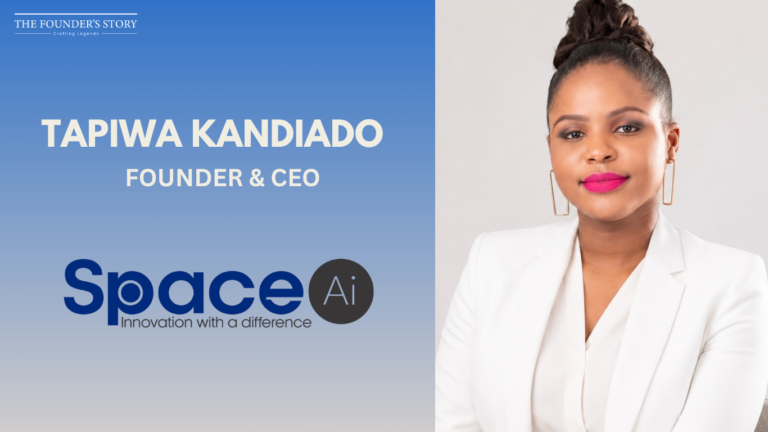
Artificial Intelligence has become one of the most influential technologies of our time. However, for many organisations across Africa, the challenge is no longer understanding AI’s potential. Instead, it is knowing how to implement AI in ways that create measurable business value. While conversations around AI continue to grow, many institutions still struggle with fragmented data, legacy workflows, limited AI readiness, and the absence of practical implementation strategies.
Recognising this opportunity, entrepreneur and Founder Tapiwa Kandiado launched SpaceAI, an African AI startup dedicated to helping organisations move beyond AI conversations and into successful AI adoption. Rather than functioning as another AI consultancy, SpaceAI partners with businesses, governments, and institutions to assess readiness, modernise data infrastructure, automate workflows, and deploy AI solutions that align with African realities, local business environments, and organisational goals.
Built with the belief that Africa should not simply consume global AI technologies but actively shape the future of Artificial Intelligence, SpaceAI combines technical expertise, strategic consulting, and implementation excellence to help organisations become AI-ready. From workflow automation and enterprise AI to data governance and AI readiness assessments, the company is empowering African institutions to embrace digital transformation with confidence.
In this exclusive interview with The Founder’s Story, Founder Tapiwa Kandiado shares her entrepreneurial journey, the inspiration behind SpaceAI, the realities of implementing AI across Africa, and her long-term vision for building globally competitive AI solutions from the continent.
TFS: Tapiwa, welcome to The Founder’s Story. It is a pleasure to have you with us today.
Tapiwa Kandiado: Thank you very much. I truly appreciate the invitation and the opportunity to share our journey.
TFS: Artificial Intelligence is dominating business conversations across the world. However, your startup focuses less on AI hype and more on AI implementation. That immediately caught our attention because it addresses one of the biggest challenges organisations face today.
Tapiwa Kandiado: Absolutely. AI has enormous potential, but conversations alone do not create transformation. Businesses need practical implementation, and that is exactly why we built SpaceAI.
TFS: We are excited to learn more about your Founder story, your entrepreneurial vision, and how SpaceAI is helping African organisations unlock the true value of Artificial Intelligence.
Tapiwa Kandiado: Thank you. I am looking forward to sharing our journey.
TFS: What was the specific moment or problem that convinced you Africa needed a company like SpaceAI not just another AI consultancy?
Tapiwa Kandiado: The turning point came when I noticed a consistent pattern across organisations in different industries. Almost everyone was discussing Artificial Intelligence, attending conferences, reading reports, and exploring new AI tools. However, very few organisations knew how to move from excitement to execution. The interest was clearly there, yet practical implementation remained missing. That observation became impossible to ignore because businesses already possessed valuable assets such as operational data, experienced employees, established customer relationships, and repetitive business processes. Nevertheless, they still struggled to convert those assets into meaningful AI-driven outcomes.
As an entrepreneur, I realised Africa did not simply need another consulting company explaining what AI could do. Instead, we needed a startup focused on helping organisations implement AI within their existing environments. Every country has unique business realities, languages, regulations, and operational challenges. Therefore, AI solutions must reflect those realities rather than simply importing global models without adaptation.
That vision became the foundation of SpaceAI. Our mission has always been to help African organisations build AI systems that integrate with local workflows, utilise their own data, and solve genuine business problems. We believe AI should become part of everyday operations rather than remaining a futuristic concept discussed only in boardrooms.
TFS: If SpaceAI didn’t exist, what’s the “second-best” option available to your clients today, and why isn’t it good enough?
Tapiwa Kandiado: Without SpaceAI, many organisations would probably rely on generic international AI platforms or traditional software vendors that have recently added AI capabilities to their products. While those options certainly offer value, they rarely address the complete challenges African organisations face during AI adoption. Technology alone cannot solve implementation problems when business processes, infrastructure, and organisational readiness have not been considered.
Many global AI platforms were developed for entirely different markets. Consequently, they may overlook local business contexts, language diversity, regulatory environments, infrastructure limitations, and the unique operational realities that African institutions experience every day. Likewise, traditional software providers often understand enterprise systems extremely well. However, they may not possess the expertise required to redesign workflows around intelligent automation and machine learning.
SpaceAI approaches implementation differently. Before introducing any technology, we assess organisational readiness, prepare data, redesign workflows, integrate secure AI solutions, train employees, and provide ongoing adoption support. In other words, we help organisations transform AI from an interesting tool into a reliable business capability. That comprehensive implementation journey is what differentiates us from simply providing software.
TFS: You’ve named the company “SpaceAI”, what does “space” mean in that name, and how does it reflect your ambition?
Tapiwa Kandiado: The word “space” represents possibility, opportunity, exploration, and limitless innovation. When I was choosing the company’s name, I wanted something that reflected much more than Artificial Intelligence itself. I wanted a name that communicated ambition. Africa has incredible talent, creativity, and entrepreneurial energy. What many innovators still need is the space to experiment, build, collaborate, and create technologies that compete on the global stage.
For me, SpaceAI symbolises that environment. It represents a place where ideas can evolve into practical solutions without artificial limitations. Although we proudly build from Africa, we have never believed our ambitions should remain local. Instead, we want African innovation to influence global conversations around Artificial Intelligence and enterprise technology.
As the Founder, I see the name as a constant reminder of our purpose. Every organisation deserves the opportunity to innovate with confidence. Likewise, every entrepreneur should feel empowered to solve complex problems regardless of geography. Therefore, SpaceAI is more than a company name. It reflects our belief that African innovation deserves room to grow, lead, and shape the future of AI worldwide.
TFS: Most conversations about AI in Africa focus on potential you’re focused on implementation. What’s the gap between the two, and where do most companies get stuck?
Tapiwa Kandiado: The difference between AI potential and AI implementation lies in preparation, organisational readiness, and disciplined execution. It is relatively easy to discuss how Artificial Intelligence could transform industries such as healthcare, agriculture, education, finance, or government. However, meaningful implementation begins by asking much more practical questions. Is the organisation’s data accurate and accessible? Are existing workflows documented? Does leadership understand the business problem they are trying to solve? Are employees prepared to work alongside AI systems?
Many organisations unintentionally start with technology rather than business outcomes. They request AI chatbots, predictive models, automation platforms, or sophisticated dashboards before evaluating whether their existing processes can actually support those solutions. Consequently, many AI projects fail because the underlying foundations were never established.
At SpaceAI, we reverse that approach. We begin by understanding the organisation’s operational challenges before recommending technology. Once the foundations are in place, Artificial Intelligence becomes far more effective because it integrates naturally into everyday work rather than disrupting it. Real transformation happens when AI improves how people perform their jobs, make decisions, and deliver value every single day.
TFS: Walk us through what an “AI readiness assessment” actually uncovers. What’s the most common blind spot you find in organizations that think they’re ready for AI and aren’t?
Tapiwa Kandiado: An AI readiness assessment goes far beyond checking whether an organisation has access to AI tools. Instead, it evaluates whether the business has the right foundation to implement Artificial Intelligence successfully and responsibly. At SpaceAI, we assess several critical areas, including data quality, data governance, existing systems, workflow maturity, leadership alignment, cybersecurity, staff capabilities, and the specific business problems the organisation wants AI to solve. Every one of these areas influences whether an AI project delivers measurable value or simply becomes another expensive experiment.
The biggest blind spot is almost always data. Many organisations confidently tell us they have years of valuable information. However, once we begin our assessment, we often discover that the data is fragmented across different systems, stored in inconsistent formats, poorly governed, or inaccessible for AI applications. Quantity alone does not create intelligence. AI depends on structured, reliable, and trustworthy data that accurately reflects business operations.
Another major blind spot involves people rather than technology. Organisations sometimes assume AI adoption is purely a technical project, yet successful implementation requires employees to understand, trust, and actively use new systems. Without change management, training, and leadership support, even the most advanced AI solution struggles to deliver lasting impact. That is why our readiness assessment focuses equally on technology, processes, and people before recommending any implementation strategy.
TFS: What’s an industry or sector in Africa that everyone assumes is “too traditional” for AI, but where you’ve seen it work surprisingly well?
Tapiwa Kandiado: One sector that consistently surprises people is the public sector. Many assume Artificial Intelligence is best suited to technology companies, digital startups, financial institutions, or multinational corporations. However, some of the strongest opportunities for AI implementation actually exist within government agencies and public institutions because many of their operations remain highly manual and process-driven.
Public institutions manage enormous volumes of documentation, compliance requirements, citizen enquiries, reporting, internal approvals, and administrative workflows every day. These activities may not appear exciting from a technology perspective, yet they consume significant time and resources. AI can dramatically improve document processing, automate routine communication, generate reports, support knowledge management, and streamline internal decision-making. As a result, employees spend less time on repetitive administrative work and more time delivering meaningful public services.
Ironically, traditional sectors often experience the greatest transformation because they begin with the highest levels of manual effort. Rather than replacing people, AI enables public servants to work more efficiently, reduce errors, and improve service delivery for citizens. As the Founder of SpaceAI, I believe these practical improvements demonstrate that AI should not be reserved for technology companies alone. Every organisation that manages information, people, and processes can benefit when implementation begins with the right business objectives.
TFS: What’s an AI trend or narrative that you think is currently overhyped and what should businesses actually be paying attention to instead?
Tapiwa Kandiado: The most overhyped narrative today is the idea that Artificial Intelligence will replace almost every job or completely transform organisations overnight. Although these headlines attract attention, they often create unnecessary fear among employees while encouraging unrealistic expectations among business leaders. Consequently, many organisations rush to purchase AI tools without first understanding how those tools fit into their existing operations.
Instead of chasing trends, businesses should focus on workflow intelligence. They should ask much simpler questions. Where do employees repeatedly perform the same manual tasks? Which processes slow customer service? Where do reporting delays affect decision-making? Which approvals consume unnecessary time? Where does valuable organisational knowledge remain difficult to access? These operational challenges represent the true starting point for AI implementation.
At SpaceAI, we believe successful Artificial Intelligence projects begin with solving practical business problems rather than showcasing impressive technology. AI should help organisations become faster, smarter, and more efficient without introducing unnecessary complexity. When businesses concentrate on improving workflows instead of collecting fashionable AI tools, they create sustainable transformation that employees actually embrace. Ultimately, value comes from solving real problems, not from following the latest technology trend.
TFS: Have you ever had to tell a client “no, you’re not ready for this” and how did that conversation go?
Tapiwa Kandiado: Yes, and although those conversations can initially feel difficult, they are often among the most valuable discussions we have with clients. Occasionally, an organisation approaches us requesting an advanced AI solution because they want to move quickly or keep pace with competitors. However, after conducting a detailed assessment, we sometimes discover that essential foundations such as organised data, documented workflows, or employee readiness are still missing.
Rather than viewing this as a failed opportunity, we treat it as the beginning of a collaborative discovery process. We explain that investing in sophisticated AI before addressing fundamental issues would almost certainly lead to disappointing results. Therefore, we recommend practical first steps such as improving data quality, mapping workflows, strengthening governance, training staff, and running smaller pilot projects. These activities create a much stronger foundation for future AI adoption.
As an entrepreneur, I believe responsible AI implementation requires honesty. Our role is not to sell the most complex technology available. Instead, our responsibility is to help organisations succeed in the long term. Sometimes the best advice we can give is to slow down, strengthen the fundamentals, and build confidence before scaling AI across the business. That approach consistently produces better outcomes for our clients and strengthens the trust they place in SpaceAI.
TFS: What’s the biggest myth business leaders have about workflow automation — something they believe that’s actively costing them money?
Tapiwa Kandiado: The biggest misconception is that workflow automation is only suitable for large enterprises with significant technology budgets. That belief prevents many organisations from exploring opportunities that could immediately improve productivity and reduce operational costs. In reality, automation does not always begin with sophisticated AI systems. Instead, it often starts by identifying repetitive tasks that consume valuable employee time every day.
Many businesses continue relying on manual approvals, repetitive data entry, document processing, customer enquiries, internal requests, and report generation because they assume automation is too expensive or too complex. However, those repetitive activities quietly accumulate hidden costs through delays, duplicated effort, human error, and reduced employee productivity. Over time, these inefficiencies have a much greater financial impact than many leaders realise.
At SpaceAI, we encourage organisations to view workflow automation as a strategic business improvement rather than simply a technology investment. Every hour employees spend on repetitive work is an hour they cannot dedicate to innovation, customer relationships, or higher-value decision-making. As a Founder, I believe successful automation begins with solving small operational challenges that gradually create significant organisational transformation.
TFS: Data infrastructure is unglamorous but foundational what’s the work that clients don’t want to pay for but absolutely need?
Tapiwa Kandiado: Without question, the least glamorous work is also the most important. Every successful AI implementation depends on clean, organised, secure, and well-governed data. Yet many organisations understandably become excited about dashboards, intelligent chatbots, predictive analytics, or workflow automation while overlooking the foundational work that makes those solutions reliable. Unfortunately, Artificial Intelligence is only as effective as the information it learns from.
That preparation involves cleaning datasets, organising information, standardising formats, documenting data sources, establishing governance policies, securing access controls, and ensuring data flows consistently across different systems. Although these activities rarely receive public attention, they determine whether AI produces trustworthy insights or inaccurate recommendations.
I often explain to clients that data infrastructure is similar to constructing the foundation of a building. Nobody admires the concrete beneath the structure, yet without it, the entire building becomes unstable. The same principle applies to Artificial Intelligence. Organisations that invest in strong data foundations create AI systems that employees can genuinely trust and depend upon. Those that ignore the groundwork often end up with impressive demonstrations that fail in everyday business operations.
TFS: How do you measure success on an engagement is it usage, cost savings, speed, something else? What number actually tells you it worked?
Tapiwa Kandiado: Every AI engagement begins with a different business challenge, so success naturally varies depending on the client’s objectives. However, one measurement consistently stands above the others: meaningful improvements in efficiency. If a process that previously required several days now takes only a few hours, that represents tangible business value. Likewise, if customer enquiries receive faster responses, reporting becomes more accurate, or employees spend more time on strategic work, then we know the implementation is creating measurable impact.
Beyond efficiency, we closely monitor user adoption. Organisations sometimes deploy excellent technology that employees rarely use. Therefore, we ask important questions throughout every project. Has the solution become part of daily operations? Are teams relying on it to perform their work? Has leadership gained greater visibility into organisational performance? Are decisions faster, more consistent, and supported by better insights?
For us, the greatest measure of success occurs when Artificial Intelligence evolves from an interesting demonstration into an essential business capability. As the Founder of SpaceAI, I believe true transformation happens when employees stop talking about the technology itself and simply begin using it naturally because it improves how they work every day.
TFS: What does the SpaceAI team look like are you hiring engineers, change-management people, both? What’s hardest to find?
Tapiwa Kandiado: SpaceAI is still an ambitious startup, and we are intentionally building a focused team that combines technical excellence with practical business understanding. At this stage of our entrepreneurial journey, I remain closely involved in shaping the company’s vision, product direction, strategic partnerships, client engagement, and implementation methodology. I spend a significant amount of time understanding organisational challenges because successful AI projects always begin with clearly defined business problems rather than technology alone.
Alongside that strategic work, we collaborate with talented software engineers, Artificial Intelligence specialists, machine learning professionals, and data infrastructure experts who help transform ideas into practical enterprise solutions. As we continue growing, we also recognise the increasing importance of change management specialists because AI adoption depends just as much on people as it does on technology.
Perhaps the most difficult talent to find is someone who naturally bridges both worlds. We need professionals who understand technical architecture while also appreciating organisational behaviour, business strategy, workflow design, and user adoption. Those individuals can communicate effectively with executives, engineers, and frontline employees alike. That rare combination has become one of the most valuable skills in modern AI implementation because technology alone never guarantees successful transformation.
TFS: Tapiwa, one of the strongest messages emerging from this conversation is that Artificial Intelligence is fundamentally about people, processes, and organisational change rather than simply algorithms and software.
Tapiwa Kandiado: I completely agree. Technology is only one part of the equation. Lasting transformation happens when people understand the purpose behind AI, trust the systems they use, and integrate them naturally into their everyday work. That is the future we are building at SpaceAI.
TFS: What would it take for an African-built AI company to compete globally, not just serve local demand and is that even the right ambition?
Tapiwa Kandiado: I absolutely believe that is the right ambition. African AI companies should never see themselves as businesses that only solve local problems. Instead, we should build solutions that address African challenges while also meeting global standards for quality, security, and innovation. Africa has unique business environments, diverse languages, and complex operational realities. Consequently, solving these challenges equips us with knowledge that can create valuable solutions for organisations around the world.
Competing globally, however, requires much more than technical talent. It demands world-class execution, robust data infrastructure, patient investment, access to international markets, and strong partnerships. Equally important, African entrepreneurs must believe that innovation developed on the continent deserves a place on the global stage. Confidence often becomes as important as capability.
At SpaceAI, our vision has always been clear. We want to build from Africa, serve African organisations exceptionally well, and eventually compete internationally with enterprise AI solutions that are practical, secure, and implementation-ready. I believe Africa should contribute to shaping the future of Artificial Intelligence rather than simply consuming technologies developed elsewhere. That is not only the right ambition—it is the responsibility of every ambitious African startup.
TFS: Five years from now, what does “AI-mature” look like for African institutions — and how far are we from that today?
Tapiwa Kandiado: For me, an AI-mature organisation is one where Artificial Intelligence is no longer viewed as a special innovation project or experimental initiative. Instead, AI becomes an integral part of everyday business operations. Employees use intelligent systems naturally to improve customer service, automate routine work, support compliance, strengthen planning, generate reports, accelerate research, and enhance decision-making. At that stage, AI quietly becomes part of the organisation’s operational DNA.
I believe African institutions are much closer to this future than many people realise. Interest in Artificial Intelligence continues to grow rapidly across both public and private sectors. Leaders increasingly recognise its potential, and employees are becoming more open to digital transformation. The remaining challenge is moving from isolated pilot projects to organisation-wide implementation supported by strong governance and clear business objectives.
Over the next five years, I hope AI becomes a trusted business capability rather than a fashionable technology trend. Organisations that invest today in data quality, workforce readiness, workflow optimisation, and responsible AI governance will be best positioned to lead that transformation. As the Founder of SpaceAI, I see tremendous optimism because the foundations are already beginning to take shape across the continent.
TFS: If you had unlimited resources for one year, what’s the one capability or infrastructure gap you’d fix first for AI adoption across the continent?
Tapiwa Kandiado: Without hesitation, I would invest in strengthening Africa’s data infrastructure. Artificial Intelligence depends on data, yet much of the continent’s valuable information remains fragmented, unstructured, inaccessible, or poorly governed. Although organisations generate enormous amounts of data every day, many still lack the systems required to organise, secure, and utilise that information effectively for AI applications.
I would prioritise building secure data platforms, improving institutional data governance, expanding labelled datasets, and developing high-quality local-language data resources. These investments would benefit far more than individual AI projects. They would strengthen innovation across healthcare, agriculture, education, finance, government, research, manufacturing, and countless other sectors that depend on reliable information to make better decisions.
Many discussions focus on access to powerful AI models, but models alone do not create meaningful transformation. The true competitive advantage lies in the quality, security, and usability of the data that powers those models. If we establish strong data foundations across Africa, we unlock opportunities for entrepreneurs, researchers, governments, and businesses to build AI solutions that genuinely reflect African realities. As a Founder, that is the investment I believe would create the greatest long-term impact for the continent.
TFS: Tapiwa, thank you for sharing such valuable insights into your Founder journey and the vision behind SpaceAI. Throughout this conversation, one message has consistently stood out. Artificial Intelligence is not simply about adopting the latest technology. Instead, it is about solving meaningful business problems through thoughtful implementation, strong data foundations, and organisational readiness. Your entrepreneurial approach demonstrates that Africa has both the talent and the ambition to lead the next generation of AI innovation.
Tapiwa Kandiado: Thank you. It has been a pleasure to share our story. I genuinely believe Africa stands at an exciting moment in its digital transformation journey. The conversations around AI are important, but now we must focus on building practical solutions that improve businesses, strengthen institutions, and create lasting value for our communities.